
No products in the cart.
Introduction
When copier paper prices increase, one of the most common explanations is “pulp prices have gone up.”
But what exactly is paper pulp, and why does it have such a significant impact on the price of A4 copier paper?
Although most office buyers never see pulp, it is one of the primary raw materials used in paper manufacturing. Changes in pulp prices can influence the production cost of copier paper, writing and printing paper, packaging paper, and several other paper grades.
However, the relationship is not always straightforward. India has a diverse paper industry that uses a mix of wood, agricultural residues, recovered paper, and imported pulp, depending on the manufacturer and the paper grade.
In this guide, we’ll explain what paper pulp is, why its prices fluctuate, and how those changes can influence copier paper prices in India.
Table of Contents
What Is Paper Pulp?
Paper pulp is the fibrous material used to manufacture paper.
It is produced by separating cellulose fibres from raw materials such as:
- Wood
- Bamboo
- Agricultural residues (such as bagasse)
- Recovered waste paper
- Cotton fibres (for specialty papers)
These fibres are cleaned, processed, and formed into paper sheets.
Without pulp, there is no paper.
Why Is Pulp So Important?
Pulp forms the structural foundation of paper.
Its quality directly affects several paper characteristics, including:
- Strength
- Smoothness
- Brightness
- Opacity
- Printability
- Durability
Premium copier papers often use carefully controlled fibre blends to deliver consistent print performance and smooth machine feeding.
Types of Pulp Used in Paper Manufacturing
Different paper grades use different types of pulp.
Virgin Wood Pulp
Produced from sustainably grown trees or plantation wood.
Commonly used for:
- Premium copier paper
- High-quality printing paper
- Writing paper
Virgin fibres generally provide higher strength and consistency.
Agricultural Residue Pulp
Produced from materials such as:
- Bagasse (sugarcane residue)
- Wheat straw
- Rice straw
India has long been a leader in using agricultural residues as an alternative fibre source, helping diversify raw material availability.
Recycled Fibre
Recovered paper is processed into reusable pulp.
It is widely used in:
- Packaging paper
- Tissue products
- Some paperboard grades
- Selected printing and writing papers
The percentage of recycled fibre varies depending on the product and manufacturer.
Imported Market Pulp
Some Indian paper manufacturers use imported market pulp, particularly for specific grades or quality requirements.
Since imported pulp is traded globally, international market conditions can influence production costs.
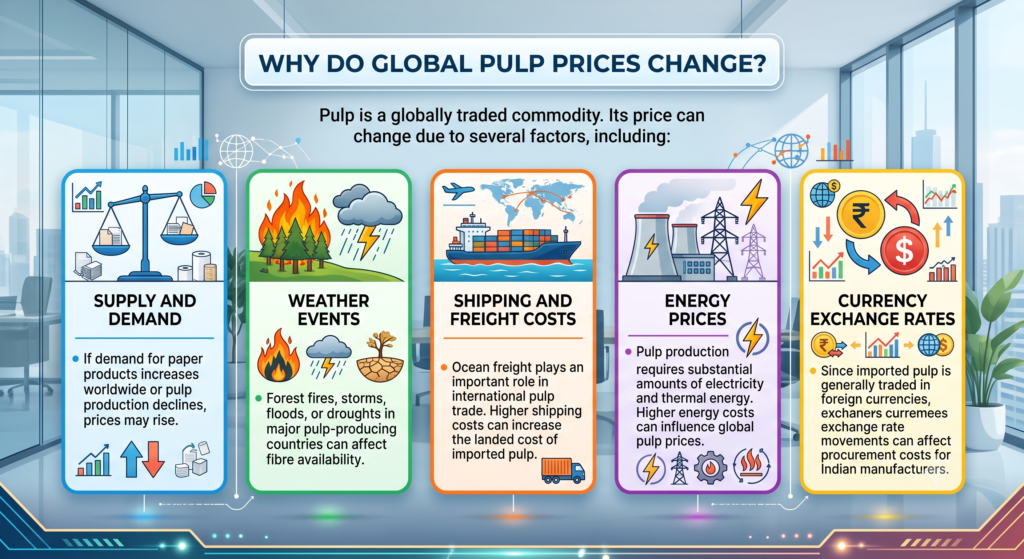
Why Do Global Pulp Prices Change?
Pulp is a globally traded commodity.
Its price can change due to several factors, including:
Does Every Indian Paper Mill Depend on Imported Pulp?
No.
This is one of the biggest misconceptions.
India has a diverse fibre base.
Different paper manufacturers use different combinations of:
- Farm forestry wood
- Bamboo
- Agricultural residues
- Recovered waste paper
- Imported pulp
As a result, the impact of international pulp prices may vary from one manufacturer to another and from one paper grade to another.
How Higher Pulp Prices Affect Copier Paper Prices
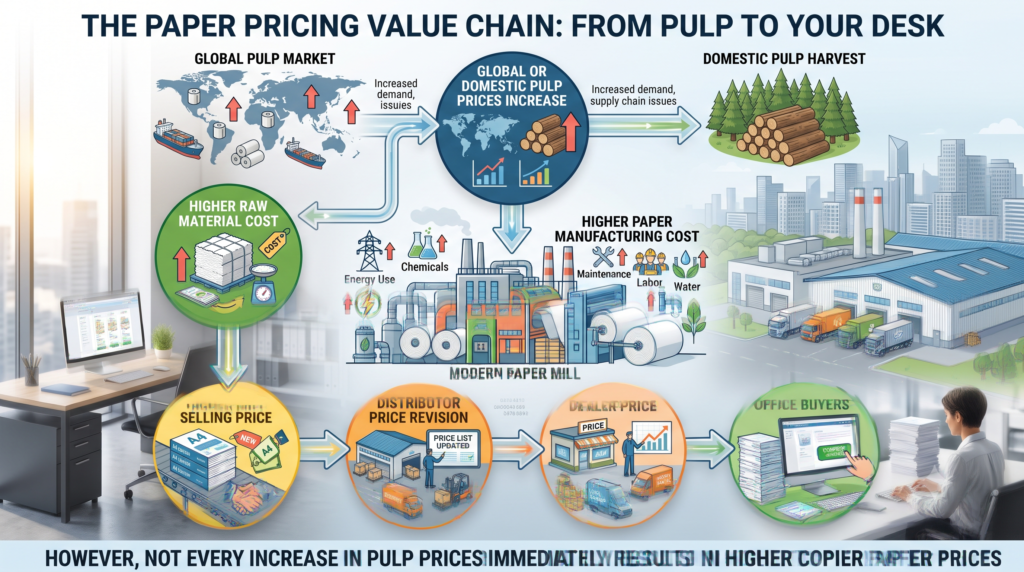
Manufacturers may also consider:
- Existing inventories
- Long-term supply contracts
- Market competition
- Customer demand
- Production efficiency
Why Don’t Copier Paper Prices Increase Overnight?
Paper manufacturers and distributors typically carry inventory.
This means:
- Existing stock may have been produced using earlier raw material costs.
- Long-term contracts may temporarily cushion market volatility.
- Competitive market conditions may delay price revisions.
Similarly, when pulp prices decline, copier paper prices may not reduce immediately because manufacturers and distributors still have inventory purchased at higher costs.
How Can Businesses Manage Pulp-Driven Price Fluctuations?
Procurement teams cannot control pulp prices, but they can reduce their exposure to market volatility.
Some practical strategies include:
- Forecast annual paper consumption.
- Consolidate purchases where feasible.
- Build relationships with reliable suppliers.
- Monitor industry developments.
- Maintain appropriate safety stock instead of overstocking.
- Compare products based on specifications, not just price.
These practices help improve procurement planning even when market prices fluctuate.
Common Myths About Pulp and Paper Prices
Myth 1: Every paper manufacturer uses imported pulp.
Reality: Indian manufacturers use different fibre sources depending on the product and production process.
Myth 2: Higher pulp prices always mean immediate paper price increases.
Reality: Inventory, contracts, and competitive market conditions often influence the timing of price revisions.
Myth 3: Lower pulp prices instantly make copier paper cheaper.
Reality: Existing inventories and broader market dynamics may delay price reductions.
Frequently Asked Questions
What is paper pulp?
Paper pulp is the fibrous raw material used to manufacture paper. It can be produced from wood, agricultural residues, recovered paper, or other cellulose-rich materials.
Why does pulp affect copier paper prices?
Pulp is one of the key raw materials used in paper manufacturing. Changes in pulp costs can influence the overall production cost of copier paper
Does India produce its own pulp?
Yes. India produces pulp from multiple fibre sources, including wood from farm forestry and agricultural residues. Some manufacturers also use imported market pulp depending on their production requirements.
Do all paper price increases happen because of pulp?
No. Paper prices are influenced by several factors, including raw materials, energy, logistics, labour, exchange rates, environmental compliance, and market demand.
Can businesses avoid paper price fluctuations?
While market prices cannot be controlled, good procurement planning, supplier relationships, and demand forecasting can help businesses manage price volatility more effectively.
Conclusion
Paper pulp may be invisible to office buyers, but it plays a central role in paper manufacturing and pricing. Understanding how pulp markets work helps businesses make more informed procurement decisions rather than reacting only to price changes.
In India, copier paper prices are shaped by a combination of domestic fibre availability, international pulp markets, energy costs, logistics, and competitive market dynamics. By understanding these factors, procurement professionals can better interpret market movements, plan purchases strategically, and build stronger supplier relationships.

Recent Comments