
No products in the cart.
Introduction
One of the most common questions from businesses purchasing copier paper, office stationery, packaging materials, or printing paper is:
“Why do paper prices keep changing?”
Unlike many office supplies, paper prices are influenced by several interconnected factors, including raw material availability, global pulp prices, energy costs, transportation expenses, seasonal demand, imports, government policies, and international market conditions.
As a result, the price of A4 copier paper, writing and printing paper, packaging paper, and paperboard may increase or decrease even when there has been no visible change in product quality.
Understanding what drives paper prices helps procurement teams make better purchasing decisions, negotiate more effectively with suppliers, and plan their procurement budgets with greater confidence.
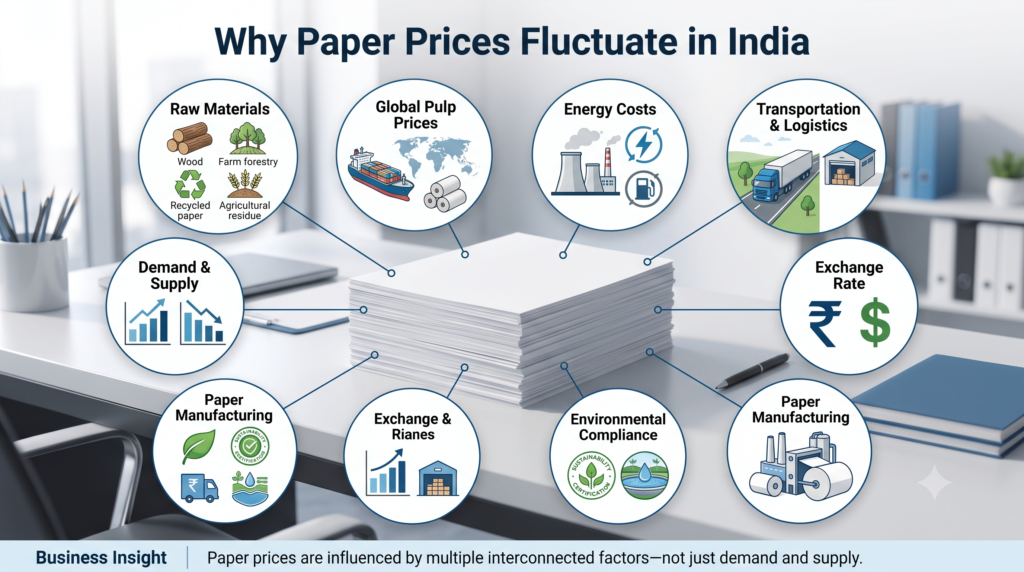
This guide explains the key factors that influence paper prices in India and why fluctuations are a normal part of the paper industry.
Table of Contents
Why Do Paper Prices Change?
Paper manufacturing is a resource-intensive industry.
Unlike products made from a single raw material, paper production depends on a combination of:
- Fibre or pulp
- Water
- Energy
- Chemicals
- Transportation
- Labour
- Packaging
- Manufacturing infrastructure
When the cost of one or more of these inputs changes significantly, paper manufacturers may revise their prices.
1. Raw Material Availability
Raw materials are one of the biggest cost components in paper manufacturing.
Indian paper mills use different fibre sources depending on the type of paper being produced, including:
- Wood from farm forestry
- Agricultural residues such as bagasse
- Recovered waste paper
- Imported pulp (for some grades and mills)
The availability and cost of these raw materials can vary due to weather, harvesting cycles, global demand, and supply chain disruptions.
Any significant change in raw material costs can influence paper prices.
2. Global Pulp Prices
Even though India has domestic paper manufacturing capacity, international pulp markets continue to influence pricing for many paper grades.
Global pulp prices are affected by:
- Supply from major pulp-producing countries
- Demand from large consuming markets
- Shipping costs
- Exchange rates
- Global economic conditions
When international pulp prices rise sharply, manufacturers that depend on imported pulp—or compete in markets influenced by global pricing—may experience increased production costs.
(We’ll explore this topic in detail in our upcoming article: How Pulp Prices Affect Copier Paper.)
3. Waste Paper Prices
Recovered paper is an important raw material for many paper mills.
Prices of waste paper can fluctuate due to:
- Domestic collection volumes
- Import availability
- Recycling demand
- Freight costs
- Global recovered paper markets
Higher recovered paper prices can increase production costs for recycled paper products.
4. Energy Costs
Paper manufacturing requires significant amounts of electricity and thermal energy.
Energy is used throughout the production process, including:
- Pulp preparation
- Paper machines
- Drying
- Finishing
- Packaging
Increases in electricity tariffs or fuel costs can contribute to higher manufacturing expenses.
5. Transportation & Logistics Costs
Paper is a heavy and bulky product.
Transport costs therefore play a significant role in the final selling price.
Factors include:
- Diesel prices
- Toll charges
- Freight availability
- Interstate transportation
- Warehouse costs
- Last-mile delivery
Even if manufacturing costs remain stable, higher logistics costs can affect market prices.
6. Seasonal Demand
Paper demand in India is not uniform throughout the year.
Demand often increases during:
- Back-to-school season
- Government procurement cycles
- Financial year-end
- Election-related printing
- Festive packaging demand
When demand rises faster than supply, prices may strengthen temporarily.
7. Import & Export Market Dynamics
India imports certain grades of pulp, waste paper, and specialty papers while also exporting paper and paperboard.
Changes in international trade can influence domestic pricing through:
- Ocean freight rates
- Global demand
- Currency movements
- Availability of imported raw materials
Although many copier papers are manufactured domestically, global markets can still have an indirect impact.
8. Exchange Rate Movements
A weaker Indian Rupee can increase the landed cost of imported:
- Pulp
- Waste paper
- Chemicals
- Machinery spare parts
This may increase manufacturing costs for mills that rely on imported inputs.
9. Environmental & Regulatory Compliance
Paper manufacturers invest continuously in:
- Effluent treatment
- Emission control
- Water management
- Energy efficiency
- Sustainable sourcing
Compliance with environmental regulations requires ongoing investment, which forms part of the overall cost structure.
10. Market Competition
Not every increase in manufacturing cost immediately results in higher paper prices.
Manufacturers also consider:
- Market competition
- Customer demand
- Existing inventories
- Distributor stocks
- Long-term business relationships
As a result, price revisions may sometimes lag behind changes in production costs.
Do Higher Prices Always Mean Better Quality?
Not necessarily.
Paper quality depends on several technical characteristics, including:
- GSM
- Brightness
- Whiteness
- Opacity
- Surface smoothness
- Fibre quality
- Manufacturing consistency
A price increase may reflect higher production costs rather than an improvement in paper quality.
Similarly, unusually low prices should prompt buyers to evaluate the product specifications carefully instead of comparing only on price.
How Businesses Can Manage Paper Price Fluctuations
Instead of reacting to every price change, organizations can adopt a structured procurement strategy:
- Forecast annual paper consumption.
- Consolidate purchases to improve negotiation.
- Compare products based on specifications, not just price.
- Maintain appropriate inventory levels.
- Build relationships with reliable suppliers.
- Monitor market trends periodically.
These practices help reduce the impact of short-term price volatility.
Frequently Asked Questions
Why do copier paper prices increase?
Copier paper prices may increase due to changes in raw material costs, global pulp prices, energy expenses, transportation costs, exchange rates, or market demand.
Are paper prices the same throughout the year?
No. Seasonal demand, procurement cycles, and market conditions can influence paper prices at different times of the year.
Does imported pulp affect paper prices in India?
For paper grades and manufacturers that rely on imported pulp, international pulp prices and exchange rate movements can influence production costs.
Should businesses buy paper only when prices are low?
Purchasing decisions should consider consumption patterns, storage capacity, cash flow, and procurement planning—not just short-term price movements.
Conclusion
Paper prices in India are influenced by a combination of domestic and global factors rather than a single cost component. Raw material availability, energy costs, logistics, international pulp markets, seasonal demand, and regulatory compliance all contribute to the final price paid by businesses.
For procurement professionals, understanding these drivers is more valuable than trying to predict short-term price changes. A well-planned procurement strategy—focused on product specifications, supplier reliability, and long-term planning—can help businesses manage costs more effectively while ensuring consistent print quality and uninterrupted operations.
Editorial note
This article should not include specific price forecasts or investment advice. Its purpose is to explain how prices move, not to predict where they will move. As the series grows, it can link to deeper articles on pulp markets, BIS standards, Ecomark, paper manufacturing, and India’s paper industry to establish Wisycart as a trusted educational resource for paper buyers.

Recent Comments