
No products in the cart.
Introduction
Most companies have a list of suppliers.
But having a list of suppliers and having an Approved Vendor List (AVL) are two different things.
A supplier may have supplied your company for years.
Another may offer the lowest quotation.
A third may be recommended by a branch manager.
But should all of them automatically be allowed to receive purchase orders?
Not necessarily.
An Approved Vendor List creates a controlled pool of suppliers that the organisation has reviewed and authorised for specific products, categories or locations.
For office supplies, this can help companies improve:
- Price consistency
- Supplier quality
- Procurement control
- Delivery reliability
- Compliance
- Spend visibility
- Vendor management
The objective isn’t to have as few suppliers as possible.
It is to have the right suppliers for the right requirements.
What Is an Approved Vendor List?
An Approved Vendor List, often called an AVL, is a maintained record of suppliers that have been evaluated and approved by an organisation.
For example:
| Category | Approved Supplier | Location |
|---|---|---|
| Copier Paper | Supplier A | Pan India |
| Toner | Supplier B | Mumbai |
| Stationery | Supplier C | Maharashtra |
| Packaging | Supplier D | Pan India |
| Housekeeping | Supplier E | Mumbai & Pune |
The list can also contain information such as:
- Supplier name
- GST details
- Contact information
- Categories supplied
- Approved locations
- Commercial terms
- Payment terms
- Delivery capability
- Contract validity
- Supplier status
- Performance rating
Why Do Companies Need an Approved Vendor List?
Without an approved vendor system, procurement can become fragmented.
One department purchases from Supplier A.
Another uses Supplier B.
A branch finds Supplier C online.
Someone uses a local supplier because they need the product urgently.
Over time, the organisation may end up with dozens of vendors supplying similar products.
This can create:
Supplier fragmentation → fragmented spend → weaker visibility → more administration
An AVL helps bring structure to this environment.
1. Start With Your Existing Suppliers
Don’t begin by searching for new vendors.
Start with the suppliers you already use.
Export your purchasing data for the last 6–12 months and identify:
- Supplier
- Product category
- Purchase value
- Purchase frequency
- Locations served
- Payment terms
- Delivery performance
You may discover that a surprisingly large percentage of your office supplies spend is concentrated among a relatively small number of suppliers.
That gives you a starting point.
2. Categorise Suppliers by What They Actually Supply
Don’t create one giant list called:
“Approved Vendors.”
Instead, classify suppliers.
For example:
Stationery
- Pens
- Files
- Notebooks
- Envelopes
Paper
- Copier paper
- Specialty paper
- Labels
Printer Consumables
- Toners
- Ink cartridges
Housekeeping
- Cleaning chemicals
- Tissue products
- Garbage bags
Packaging
- Corrugated boxes
- Tapes
- Stretch film
A supplier can be approved for one category without automatically being approved for every category.
3. Define Minimum Vendor Requirements
Before approving a supplier, decide what information you actually need.
Depending on your organisation and category, this may include:
Basic Information
- Legal name
- Address
- Contact person
- Contact details
Tax & Compliance
- PAN
- GST details
- Relevant registrations or documentation
Commercial Information
- Price list
- Payment terms
- Credit period
- MOQ
- Delivery charges
Operational Information
- Serviceable locations
- Lead times
- Delivery capability
- Replacement process
Product Information
- Brands
- Specifications
- Certifications, where applicable
Not every supplier requires the same level of documentation.
A low-value stationery supplier doesn’t necessarily need the same onboarding process as a critical strategic supplier.
4. Evaluate Quality
Price should not be the only approval criterion.
Ask:
Does the supplier consistently provide the required product specification?
For office supplies, this might mean checking:
- Product quality
- Specification consistency
- Packaging
- Damage rate
- Product authenticity, where relevant
- Replacement history
A supplier offering a low quotation but repeatedly delivering unsuitable products may create more work than savings.
5. Evaluate Delivery Performance
A supplier isn’t truly reliable because they promise:
“We’ll deliver in two days.”
Measure what actually happens.
Track:
Promised delivery date
versus
Actual delivery date
Over time, you can calculate:
On-Time Delivery %
This provides a much more objective view of supplier reliability.
6. Check Geographic Coverage
This is particularly important for businesses with multiple branches.
A supplier may be excellent in:
Mumbai
but unable to efficiently serve:
Delhi, Bengaluru, Hyderabad or Kolkata.
So an AVL should ideally specify:
Where is this supplier approved to supply?
For example:
Supplier A — Copier Paper — Maharashtra
Supplier B — Copier Paper — Pan India
Supplier C — Stationery — Mumbai only
This avoids assuming that one supplier is suitable for every location.
7. Evaluate Commercial Competitiveness
An approved supplier doesn’t have to be the cheapest supplier in every transaction.
But their commercial terms should remain competitive.
Review:
- Unit pricing
- Volume discounts
- Delivery charges
- MOQ
- Payment terms
- Contract pricing
- Price revision frequency
For frequently purchased products, negotiated rate cards can provide better control than repeatedly requesting quotations.
8. Don’t Approve Too Many Suppliers
This is a common mistake.
A company may think:
“More approved suppliers means more competition.”
Sometimes it does.
But excessive supplier numbers can create:
- Fragmented spend
- More invoices
- More reconciliations
- More vendor communication
- Lower negotiating leverage
- Greater administrative workload
The objective isn’t:
Maximum suppliers.
It is:
Adequate supplier choice with manageable complexity.
9. Keep More Than One Supplier Where Necessary
Supplier consolidation should not mean putting all your eggs in one basket.
For important categories, consider maintaining:
Primary Supplier
The preferred supplier for normal requirements.
Secondary Supplier
An approved alternative if the primary supplier cannot fulfil the requirement.
This can be useful for categories where stockouts could disrupt operations.
For example:
A4 Copier Paper
Primary → Supplier A
Backup → Supplier B
This provides some resilience without maintaining ten different suppliers.
10. Create Supplier Statuses
Not every supplier has to be simply “Approved” or “Rejected.”
A practical system can use:
Approved
Fully authorised for normal purchasing.
Conditional
Approved for specific products, locations or circumstances.
Probation
Being evaluated based on initial performance.
Suspended
Temporarily blocked due to performance or compliance issues.
Inactive
No longer being used but retained for historical records.
This creates better control than simply deleting vendors from the system.
11. Define Who Can Add a New Vendor
This is critical.
If every employee can add a supplier, the AVL quickly loses its purpose.
Define an approval process.
For example:
Business Requirement
↓
Supplier Details Submitted
↓
Procurement Review
↓
Commercial Evaluation
↓
Compliance Check
↓
Approval
↓
Vendor Created in System
The exact process will vary by organisation.
The principle is simple:
Vendor creation should be controlled.
12. Create an Exception Process
Sometimes an unapproved supplier really is necessary.
For example:
- Emergency requirement
- Approved supplier unavailable
- Location-specific requirement
- Unique product
- Temporary supply disruption
Don’t force employees to bypass procurement rules.
Create a formal exception process.
For example:
Exception Requested
→ Reason documented
→ Manager approval
→ Procurement review
→ Purchase allowed
→ Exception recorded
This preserves control while allowing operational flexibility.
13. Measure Supplier Performance
Approval shouldn’t be permanent simply because a supplier passed onboarding six years ago.
Review suppliers periodically.
Useful KPIs include:
On-Time Delivery
Did the supplier deliver when promised?
Order Accuracy
Was the correct product and quantity supplied?
Quality
Did the product meet requirements?
Responsiveness
How quickly does the supplier respond?
Replacement Performance
How efficiently are damaged or incorrect products replaced?
Price Competitiveness
Are commercial terms still reasonable?
14. Use a Supplier Scorecard
A simple scorecard can look like this:
| Criteria | Weight |
|---|---|
| Price | 25% |
| Quality | 20% |
| Delivery | 20% |
| Reliability | 15% |
| Service | 10% |
| Compliance | 10% |
These weights are illustrative.
Different categories require different priorities.
For a critical consumable, reliability may deserve greater weight.
For a commodity product, price may carry more weight.
The important part is having defined criteria instead of purely subjective supplier decisions.
15. Review Your AVL Periodically
Your supplier landscape changes.
Prices change.
Companies change.
Service levels change.
New suppliers enter the market.
Existing suppliers may stop being competitive.
Therefore, review the AVL periodically.
For example:
Monthly
Monitor supplier performance.
Quarterly
Review pricing and service.
Annually
Conduct a broader supplier review.
The frequency should depend on category importance and procurement volume.
Sample Approved Vendor List
A basic AVL could look like this:
| Supplier | Category | Locations | Status | Payment Terms | Review Date |
|---|---|---|---|---|---|
| Supplier A | Copier Paper | Pan India | Approved | 30 Days | Dec 2026 |
| Supplier B | Toner | Mumbai | Approved | 30 Days | Dec 2026 |
| Supplier C | Stationery | Maharashtra | Conditional | 15 Days | Oct 2026 |
| Supplier D | Packaging | Pan India | Approved | 45 Days | Dec 2026 |
| Supplier E | Housekeeping | Mumbai | Probation | 30 Days | Oct 2026 |
This simple structure can already provide much better visibility.
What an AVL Should Not Become
An Approved Vendor List should not become a document that says:
“Only these vendors may ever be used.”
Markets change.
New suppliers emerge.
Existing suppliers can fail.
Business requirements change.
A good AVL should provide control with flexibility, not create unnecessary restrictions.
Approved Vendor List vs Preferred Vendor List
These terms are sometimes used interchangeably, but they can represent different concepts.
Approved Vendor
The supplier has passed the organisation’s required checks and is permitted to supply.
Preferred Vendor
The organisation actively prefers this supplier because of factors such as pricing, service, quality, coverage or strategic relationship.
You can therefore have:
10 Approved Vendors
but only:
3 Preferred Vendors
for a particular category.
That distinction can be useful.
How Procurement Technology Helps
Maintaining an AVL in a spreadsheet is possible for a small organisation.
As the company grows, it becomes harder.
A procurement system can maintain:
- Supplier master
- Approval status
- Product categories
- Location coverage
- Contracts
- Rate cards
- Documents
- Performance metrics
- Review dates
It can also prevent employees from selecting suppliers who are not approved for a particular category or location.
That turns the AVL from a static document into an active procurement control.
The 10-Point AVL Checklist
Before approving a supplier, ask:
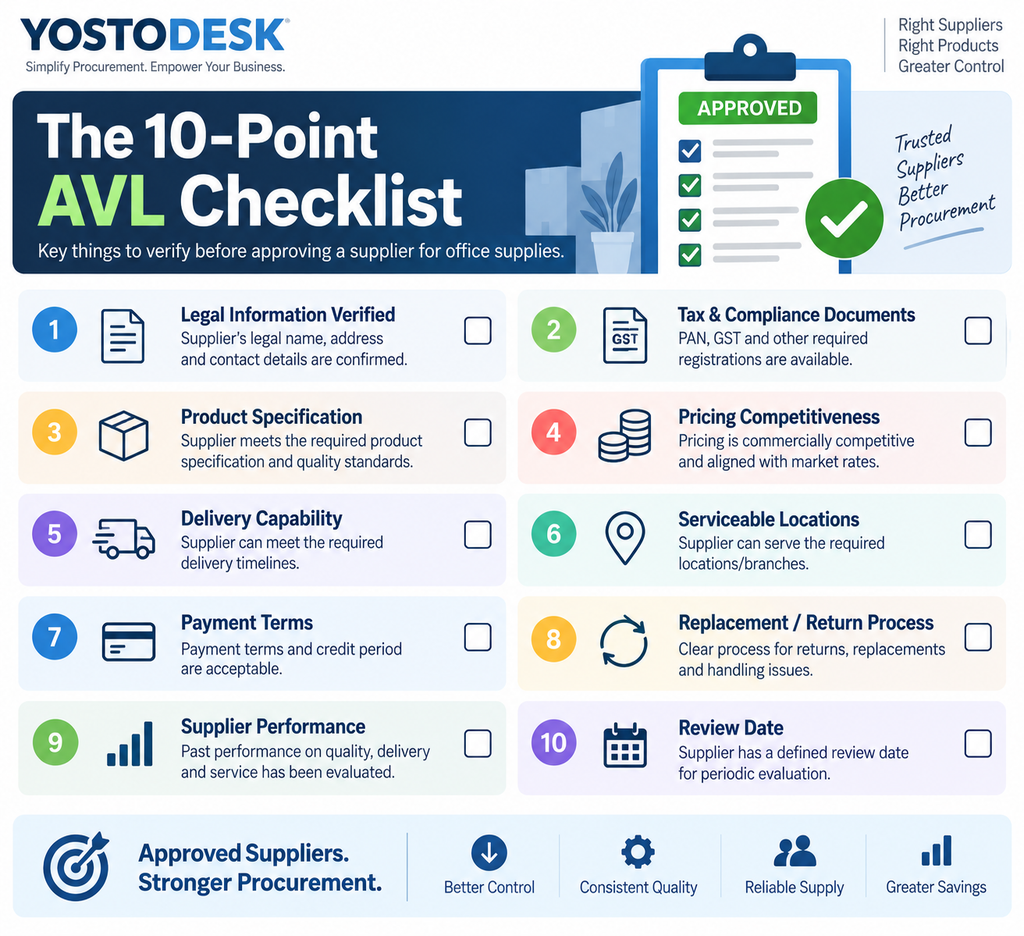
If the answer to these questions is clear, the organisation has a much stronger foundation for supplier management.
Conclusion
An Approved Vendor List isn’t simply a list of suppliers.
It is a procurement control mechanism.
Done properly, it can help organisations:
- Reduce supplier fragmentation
- Improve spend visibility
- Standardise purchasing
- Improve supplier accountability
- Reduce uncontrolled buying
- Maintain backup suppliers
- Improve commercial negotiations
But the goal shouldn’t be to eliminate supplier choice.
It should be to create informed supplier choice.
The best AVL answers three questions:
Who can we buy from?
What can we buy from them?
Where can they supply us?
And just as importantly:
How do we know they are still performing?
That is what turns a vendor list into a procurement management system.
This is where a procurement platform such as Yostodesk can become useful. Instead of managing branch requirements, supplier communication, product lists and purchasing information separately across spreadsheets, emails and WhatsApp conversations, organisations can create a more structured procurement workflow

Recent Comments