
No products in the cart.
Introduction
For most offices, copier paper is a simple purchase:
A4 → 75 GSM or 80 GSM → choose a brand → compare price → order.
But there is a regulatory framework behind plain copier paper sold in India.
The Bureau of Indian Standards (BIS) has a dedicated Indian Standard for Plain Copier Paper: IS 14490.
More importantly, this is not merely a voluntary quality benchmark. Plain copier paper has been under a mandatory BIS certification framework since the Plain Copier Paper (Quality Control) Order, 2020. The original order referred to IS 14490:2018 and required the Standard Mark under a BIS licence. The order also states that the latest version of the Indian Standard notified by BIS applies from the date of such notification.
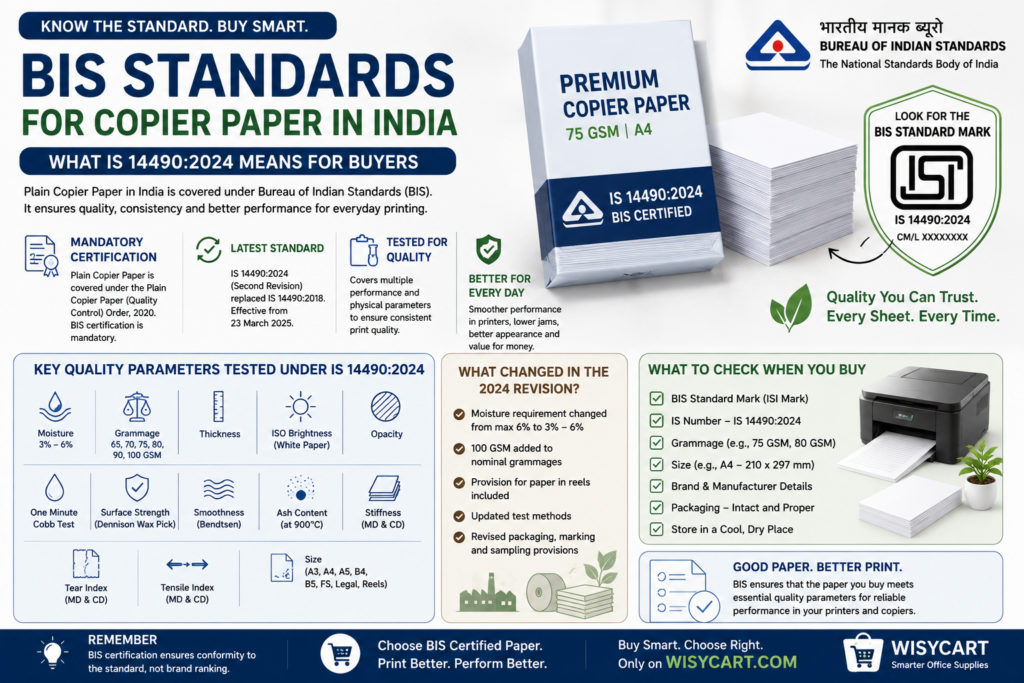
BIS subsequently revised the standard from IS 14490:2018 to IS 14490:2024, titled Plain Copier Paper — Specification (Second Revision). BIS’s implementation circular stated that the old and revised standards ran concurrently until 23 March 2025, after which the revised standard was to be implemented.
So, for buyers in India, the relevant technical standard today is IS 14490:2024.
But what does it actually cover?
And does a BIS mark mean that one paper is automatically better than another?
Let’s break it down.
Table of Contents
What Is IS 14490?
IS 14490:2024 is the Indian Standard for Plain Copier Paper.
It establishes requirements and test methods covering the physical and performance characteristics of the paper.
BIS’s current product manual identifies the product as:
Plain Copier Paper — Specification
and provides the certification framework for manufacturers and paper converters.
The standard is relevant to paper used in applications such as:
- Photocopiers
- Laser printers
- Office multifunction devices
- General document printing
The important point is that BIS certification is concerned with the paper’s conformity to specified requirements, not simply its appearance.
Is BIS Certification Mandatory for Copier Paper in India?
Yes, for plain copier paper covered by the applicable Quality Control Order.
The Plain Copier Paper (Quality Control) Order, 2020 requires the specified product to conform to the applicable Indian Standard and bear the Standard Mark under a BIS licence. It also states that the latest version of the Indian Standard notified by BIS applies.
BIS’s 2025 implementation circular specifically confirms that plain copier paper remains under mandatory certification and that IS 14490:2024 replaced IS 14490:2018 after the transition period.
This matters for manufacturers, converters and importers.
For an ordinary office buyer, the practical takeaway is simpler:
When purchasing plain copier paper in India, look for the applicable BIS Standard Mark and verify the certification details where necessary.
IS 14490:2018 vs IS 14490:2024
The revision did not simply change the number.
BIS identified several changes between the 2018 and 2024 versions.
Among them:
| Area | Change in IS 14490:2024 |
|---|---|
| Standard | Revised from IS 14490:2018 |
| Moisture | Requirement changed from maximum 6% to a range of 3%–6% |
| Grammage | 100 GSM added to the specified nominal grammages |
| Sizes | Provision for paper in reels added |
| Testing methods | Several referenced test methods updated |
| Packaging | Packaging provisions revised |
| Marking | Marking requirements updated |
| BIS certification marking | Updated |
| Sampling | Sampling from reels incorporated |
These changes are documented in BIS’s implementation circular.
The revised BIS product manual lists the nominal grammages within its licensing scope as:
65, 70, 75, 80, 90 and 100 GSM.
It also lists cut sizes including A3, A4, A5, B4, B5, FS and Legal, as well as reels.
What Does BIS Actually Test?
This is where the standard becomes particularly interesting.
BIS certification for plain copier paper is not based on GSM alone.
The BIS product manual identifies testing across a range of characteristics, including:
- Moisture
- Grammage
- Thickness
- Size
- ISO Brightness
- Opacity
- One-minute Cobb test
- Surface strength / Dennison Wax Pick
- Smoothness
- Ash content
- Taber stiffness
- Tear index
- Tensile index
The BIS laboratory system currently lists these parameters for IS 14490:2024 testing.
That is a much more comprehensive quality framework than simply saying:
“This is 80 GSM paper.”
Understanding the Important BIS Parameters
1. Grammage — GSM
Grammage is the mass of paper per unit area, normally expressed as grams per square metre (g/m²), commonly called GSM.
For example:
- 70 GSM
- 75 GSM
- 80 GSM
- 90 GSM
GSM is important because it affects the feel, weight and handling characteristics of paper.
However:
Higher GSM does not automatically mean better copier paper.
The standard itself evaluates several characteristics in addition to grammage.
2. Thickness
Two sheets can have the same GSM but different thicknesses.
Thickness influences:
- Sheet handling
- Stiffness
- Feeding behaviour
- Perceived substance
That is why BIS treats thickness separately from grammage.
BIS’s testing framework specifically includes thickness as a separate requirement under IS 14490:2024.
3. Moisture
Moisture is particularly important for copier paper.
Paper is hygroscopic and responds to the surrounding environment.
Excessive or uncontrolled moisture can contribute to:
- Curling
- Feeding problems
- Sheet sticking
- Printing problems
Under the revised IS 14490:2024, BIS’s implementation circular states that the moisture requirement changed from maximum 6% under the earlier standard to a range of 3% to 6%.
This is particularly relevant in India because paper can experience significant environmental changes during storage and transportation.
4. ISO Brightness
Brightness is a measure of how much blue light a paper reflects under a specified measurement method.
Higher brightness can improve the apparent contrast between the paper and printed text.
But brightness should not be confused with whiteness.
They are different measurements.
The revised BIS standard includes ISO brightness as one of its specified test parameters, with the requirement applying to white paper.
5. Opacity
Opacity measures how much light is blocked by the paper.
For office printing, this matters particularly when documents are printed on both sides.
Higher opacity generally helps reduce show-through of printing from the reverse side.
BIS includes opacity as a specific test parameter under IS 14490:2024.
6. Cobb Test
The one-minute Cobb test measures the amount of water absorbed by paper under a specified test procedure.
Why does this matter for copier paper?
Paper’s interaction with moisture influences its handling and dimensional behaviour.
BIS includes the one-minute Cobb test for both sides of the paper in its IS 14490:2024 testing framework.
This is a good example of why copier paper quality cannot be judged simply by looking at a sheet.
7. Surface Strength — Dennison Wax Pick
The Wax Pick test evaluates the surface strength of paper.
In simple terms, it helps assess how well the paper surface holds together when subjected to the test.
Why does this matter?
A weak paper surface can contribute to:
- Fibre or dust release
- Surface picking
- Printing equipment contamination
BIS includes Dennison Wax Pick as one of the specified tests.
8. Smoothness
Smoothness affects the interaction between the paper surface and printing process.
BIS specifies Bendtsen smoothness testing for both sides under IS 14490:2024.
For users, good surface characteristics can contribute to consistent print appearance and paper handling.
9. Ash Content
Ash content measures the inorganic residue remaining after the paper is combusted under the specified test conditions.
BIS includes ash content determination at 900°C among the specified tests.
This is primarily a technical manufacturing-quality parameter rather than something an office buyer can judge visually.
10. Stiffness
BIS uses the Taber stiffness test in both:
- Machine Direction (MD)
- Cross Direction (CD)
Stiffness influences how a sheet behaves when handled and fed through equipment.
The distinction between machine direction and cross direction is important because paper is not mechanically identical in every direction.
11. Tear Index
Tear index evaluates resistance to tearing relative to paper mass.
BIS specifies tear index in both:
- Machine Direction
- Cross Direction
This is another measure that helps assess the mechanical performance of the paper.
12. Tensile Index
Tensile index evaluates the paper’s tensile strength relative to its grammage.
Again, BIS specifies the test in both machine and cross directions.
For a procurement professional, the larger lesson is simple:
Paper strength is multidimensional. GSM alone cannot describe it.
What Does BIS Certification Mean for a Buyer?
A BIS-certified product is not simply “paper that has a logo.”
The manufacturer or converter operates under a BIS certification framework and the product is required to conform to the applicable standard.
BIS’s product manual requires quality assurance, testing and maintenance of records. It also distinguishes between paper mills producing copier paper and paper converters that purchase ISI-marked paper in bulk and process/cut it into finished cut-size paper.
This is particularly interesting for A4 paper.
The sheet you buy may have been produced through a chain involving:
Paper Mill → Reel → Converter → A4 Cutting & Packing → Finished Ream
BIS’s framework addresses this chain.
What Should You Look for on a Copier Paper Ream?
When buying copier paper, check the packaging for:
1. BIS Standard Mark
The BIS product manual states that the Standard Mark is to be displayed on the package of each ream or reel, subject to the certification requirements.
2. IS Number
Look for the applicable Indian Standard reference:
IS 14490:2024
3. Manufacturer Information
Check:
- Manufacturer name
- Brand
- Product description
4. Grammage
For example:
75 GSM
or
80 GSM
5. Size
For example:
A4 — 210 × 297 mm
6. Certification Details
Where required for procurement or verification, the BIS licence/certification details can be checked against the relevant BIS records.
Does BIS Certification Mean All BIS-Certified Paper Is Identical?
Absolutely not.
This is an important distinction.
BIS certification establishes conformity with the applicable standard.
It does not mean that every certified brand will have identical:
- Brightness
- Surface feel
- Smoothness
- Opacity
- Print appearance
- Packaging
- User experience
A product can comply with a standard while another product may perform beyond the minimum requirements or have different characteristics within the permitted specification.
Therefore:
BIS compliance is a baseline of conformity—not a ranking of brands.
Is 80 GSM Always Better Than 75 GSM?
No.
This is one of the most common mistakes in paper procurement.
An 80 GSM paper is heavier than a 75 GSM paper, but “better” depends on the application.
75 GSM may be appropriate for:
- High-volume internal documents
- Routine office printing
- Everyday photocopying
80 GSM may be preferred for:
- Reports
- Presentations
- Client-facing documents
- Documents where a heavier feel is desirable
But GSM should be considered alongside other paper characteristics and the printer manufacturer’s recommendations.
Does BIS Certification Guarantee Jam-Free Printing?
No.
This is an important point.
BIS certification establishes conformity with specified requirements. It does not guarantee that a sheet will never jam in every printer.
Paper feeding also depends on:
- Printer condition
- Paper storage
- Humidity
- Printer settings
- Paper compatibility
- Loading
- Roller condition
- Handling
A perfectly compliant paper can still perform poorly if it has been stored in unsuitable conditions.
Does BIS Certification Mean the Paper Is Environmentally Sustainable?
Not automatically.
BIS certification and environmental certification are different concepts.
BIS certification focuses on conformity with the applicable Indian Standard.
Environmental credentials may involve separate schemes or certifications such as:
- Ecomark
- FSC
- PEFC
- Recycled-content claims
A buyer should therefore avoid treating:
BIS = Sustainable
as a correct equation.
They address different questions.
BIS vs ISO: Are They the Same?
No.
BIS is India’s national standards body.
ISO is an international standards organization.
An Indian Standard may adopt or reference international test methods. For example, the BIS product manual references ISO methods for certain testing parameters, including ISO 2470-1 for brightness and ISO 2471 for opacity.
So seeing an ISO test method referenced within an Indian Standard does not mean that BIS certification and ISO certification are the same thing.
What Changed in the 2024 Revision?
The revision is important because it shows that the Indian standard is not static.
Among the changes identified by BIS:
- Moisture requirement changed to 3%–6%
- 100 GSM added to nominal grammage scope
- Reel packaging incorporated
- Several test-method references updated
- Packaging requirements revised
- Marking provisions updated
- BIS certification marking updated
- Sampling provisions expanded to include reels
For manufacturers and converters, these are meaningful changes.
For procurement teams, they reinforce an important point:
When a standard is revised, old product specifications and old compliance documents should not automatically be assumed to represent the current requirement.
A Practical Copier Paper Procurement Checklist
Before placing a bulk order, procurement teams should check:
| Check | What to verify |
|---|---|
| BIS | Applicable BIS Standard Mark/certification |
| Standard | IS 14490:2024 |
| GSM | Required grammage |
| Size | A4, A3 or required format |
| Brightness | Suitable for intended application |
| Opacity | Important for duplex printing |
| Moisture | Storage and environmental suitability |
| Printer compatibility | Suitable for the equipment |
| Packaging | Intact and appropriate for storage |
| Supplier | Reliable source with proper documentation |
For large institutional or corporate procurement, it can also be useful to request relevant test certificates or conformity documentation from the supplier where the procurement specification calls for it.
BIS’s product manual itself provides a test-certificate format containing parameters such as moisture, grammage, thickness, ISO brightness, opacity, Cobb, surface strength, smoothness, ash, stiffness, tear index, tensile index and size.
A Note for Buyers of Imported Copier Paper
The mandatory certification framework is particularly relevant when considering imported products.
The original Quality Control Order requires the specified product to conform to the applicable Indian Standard and bear the Standard Mark; it specifically exempts goods or articles meant for export.
Therefore, an overseas paper specification or foreign certification should not automatically be treated as a substitute for the applicable Indian BIS requirement when the product is being supplied in the Indian market.
For import procurement, certification and regulatory status should be verified before shipment and sale.
What BIS Does — and Does Not — Tell You
A useful way to think about BIS is:
BIS helps answer:
“Does this product conform to the applicable Indian Standard?”
It does not automatically answer:
“Which brand is best?”
It does not automatically answer:
“Which paper gives the best print quality for my particular printer?”
And it does not automatically answer:
“Which paper is the most sustainable?”
Those are separate procurement questions.
Frequently Asked Questions
Is BIS certification mandatory for A4 copier paper in India?
Plain copier paper is subject to mandatory BIS certification under the Plain Copier Paper (Quality Control) Order, 2020. The order originally referenced IS 14490:2018 and provides that the latest version notified by BIS applies. BIS subsequently revised the standard to IS 14490:2024.
What is the current BIS standard for plain copier paper?
The revised standard is IS 14490:2024 — Plain Copier Paper — Specification (Second Revision). BIS’s implementation guidance set 23 March 2025 as the final implementation date following concurrent running with the 2018 version.
What GSM does IS 14490:2024 cover?
BIS’s product manual lists 65, 70, 75, 80, 90 and 100 GSM within the nominal grammage scope for licensing.
Does IS 14490:2024 cover A4 paper?
Yes. The BIS product manual lists A4 among the cut-size categories covered under the licensing scope.
What tests are performed on copier paper?
The BIS framework includes tests/requirements covering moisture, grammage, thickness, size, ISO brightness, opacity, Cobb absorption, surface strength, smoothness, ash content, stiffness, tear index and tensile index.
Does higher GSM mean better paper?
No. GSM is only one characteristic. Copier paper performance also depends on properties such as moisture, opacity, smoothness, stiffness, surface strength and other parameters.
Does BIS certification guarantee paper will never jam?
No. Printer condition, storage, humidity, paper handling and equipment compatibility can all affect paper feeding.
Conclusion
The next time someone says:
“It’s just A4 paper.”
there is actually quite a lot behind that simple sheet.
India has a specific regulatory and technical framework for plain copier paper. IS 14490:2024 covers considerably more than GSM, including moisture, thickness, brightness, opacity, surface strength, smoothness, stiffness and mechanical properties.
For businesses, the practical lesson is straightforward:
Don’t buy copier paper only by GSM and price.
Check the applicable BIS certification, understand the paper specifications, consider your printer requirements, and pay attention to storage and handling.
For procurement teams buying thousands of reams every year, these details aren’t academic. They can influence print performance, wastage, equipment downtime and ultimately the true cost of office printing.
The better procurement question is not:
“Which A4 paper is cheapest?”
It is:
“Which compliant paper gives us the right balance of quality, performance and total cost for our actual use?”
Sources
- BIS — Implementation Guidelines for IS 14490:2024: Revision from IS 14490:2018, mandatory certification status, transition date and key changes.
- BIS — Product Manual for IS 14490:2024: Licensing scope, grammages, sizes, testing framework, marking and certification procedures.
- BIS LIMS — IS 14490:2024: Current testing parameters and laboratories recognised for testing against the revised standard.
- Government of India — Plain Copier Paper (Quality Control) Order, 2020: Mandatory Standard Mark framework and application of the latest notified Indian Standard.

Recent Comments