
No products in the cart.
Introduction
A company with one office can usually manage stationery and office supplies without much complexity.
But what happens when the company has:
- 5 offices?
- 20 branches?
- 100 retail stores?
- Warehouses in different cities?
- Employees working across multiple locations?
A simple question suddenly becomes complicated:
Should every location purchase its own office supplies, or should the company centralize procurement?
Both models have advantages.
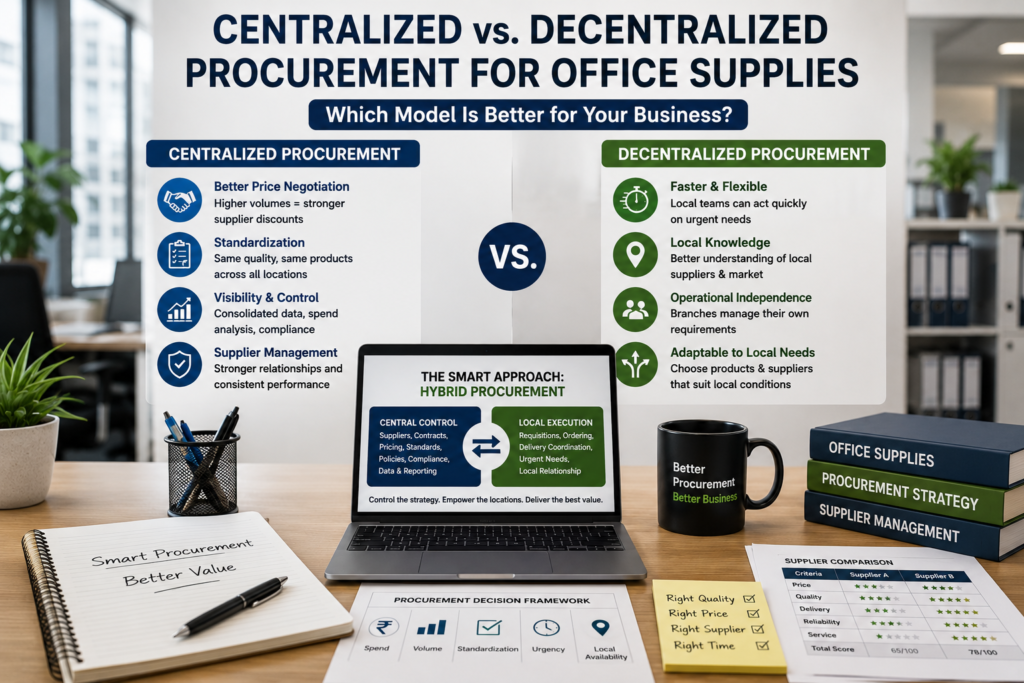
Centralized procurement can improve pricing, standardization and control.
Decentralized procurement can improve speed, flexibility and local responsiveness.
The right answer depends on the company’s size, geography, product categories, approval structure and operational requirements.
This guide compares both models and explains how businesses can decide which approach works best for office supplies.
Table of Contents
What Is Centralized Procurement?
In a centralized procurement model, a central procurement or purchase team manages purchasing decisions for multiple locations.
For example:
Head Office Procurement Team
↓
Approved Suppliers
↓
Mumbai Office | Delhi Office | Bengaluru Office | Pune Office
The individual offices may request supplies, but purchasing decisions and supplier relationships remain centrally controlled.
What Is Decentralized Procurement?
In a decentralized model, individual offices or branches manage their own purchasing.
For example:
Mumbai Office → Local Supplier
Delhi Office → Local Supplier
Bengaluru Office → Local Supplier
Each location may choose:
- Supplier
- Product
- Quantity
- Price
- Delivery arrangement
This provides flexibility but can also create inconsistency.
Centralized vs Decentralized Procurement
| Factor | Centralized | Decentralized |
|---|---|---|
| Price negotiation | Stronger | Usually weaker |
| Standardization | High | Low to moderate |
| Local flexibility | Lower | Higher |
| Supplier control | High | Fragmented |
| Procurement visibility | High | Lower |
| Ordering speed | Can be slower | Usually faster |
| Local supplier relationships | Limited | Strong |
| Data consolidation | Easier | Difficult |
| Compliance control | Stronger | More variable |
Neither model is automatically superior.
The real question is:
Which model fits the organisation’s operating structure?
1. Price Negotiation
This is one of the strongest arguments for centralization.
Suppose ten offices each purchase:
100 reams of paper per month.
Individually:
100 reams × 10 offices = 1,000 reams
But if procurement consolidates the requirement, it can negotiate based on the company’s total volume.
The supplier now sees:
1,000 reams/month
rather than ten unrelated orders of 100 reams.
This may improve negotiating power.
However, businesses should not assume that consolidation automatically guarantees the lowest price.
Freight, delivery locations, payment terms and service requirements also matter.
2. Standardization
Decentralized procurement can create a surprisingly common problem:
Same company → five offices → five different products.
For example:
Mumbai uses 75 GSM paper.
Delhi uses 80 GSM.
Bengaluru uses another brand.
Pune uses an entirely different specification.
This creates unnecessary complexity.
Centralized procurement can establish an approved catalogue:
Copier Paper
- Standard office paper
- Premium paper
- Special-purpose paper
Toners
- Approved printer-specific SKUs
Files
- Standard sizes and formats
Housekeeping
- Approved products and specifications
This makes purchasing easier and improves consistency.
3. Procurement Visibility
Centralized procurement makes it easier to answer:
“How much does our company spend on office supplies every month?”
Without consolidated data, the answer may be surprisingly difficult.
One branch may record stationery under:
Office Expenses
Another under:
Administrative Expenses
Another under:
Consumables
Another may use a different accounting category.
Centralized purchasing and standardized SKU structures can make spend analysis significantly easier.
4. The Biggest Advantage of Decentralized Procurement: Speed
Centralization isn’t perfect.
Imagine a branch urgently needs:
Printer paper today.
If every purchase requires:
Branch request
↓
Regional approval
↓
Central procurement
↓
Quotation
↓
Purchase order
↓
Supplier dispatch
the process can become unnecessarily slow.
A local branch may be able to solve the problem in 30 minutes.
This is where decentralized procurement wins.
5. Local Knowledge Matters
A supplier that works well in Mumbai may not be equally effective in Guwahati.
Local procurement teams understand:
- Local suppliers
- Delivery conditions
- Local logistics
- Availability
- Regional product preferences
- Emergency requirements
Central procurement can sometimes underestimate these differences.
6. The Hidden Problem: Maverick Buying
One of the biggest challenges in decentralized procurement is maverick buying.
This happens when employees or locations purchase outside approved suppliers, contracts or procurement processes.
For example:
Corporate procurement negotiates a contract for:
A4 Paper — ₹200/ream
But a branch independently purchases another brand at:
₹225/ream
because it was convenient.
One branch may not seem significant.
Multiply that across 50 branches and 12 months.
The leakage can become substantial.
7. Centralization Can Create Its Own Problem
There is an opposite risk:
Over-centralization.
A central team may try to control every ₹200 stationery purchase.
That creates:
- Too many approvals
- Administrative workload
- Slow ordering
- Frustrated employees
- Excessive bureaucracy
Good procurement is not about controlling everything.
It is about controlling what needs to be controlled.
8. The Best Answer May Be Hybrid Procurement
For many companies, the best model isn’t:
100% centralized
or
100% decentralized.
It is:
Centralized Strategy + Local Execution
For example:
Central Team Controls
- Approved suppliers
- Product specifications
- Negotiated pricing
- Contracts
- Payment terms
- Supplier performance
- Procurement policy
Local Teams Control
- Requisition
- Quantity required
- Delivery timing
- Routine ordering
- Emergency purchases within limits
This gives the company control without unnecessary bureaucracy.
A Practical Hybrid Model
Consider a company with 50 branches.
The central procurement team creates an approved catalogue:
A4 Paper — Brand A / Brand B
Toner — Approved SKUs
Files — Approved Specifications
Cleaning Supplies — Approved Products
Each branch can order from this catalogue.
But it cannot freely purchase outside the catalogue unless:
Exception → Approval → Purchase
This model creates a balance between:
Control + Speed
Which Office Supplies Should Be Centralized?
Not every category needs the same procurement model.
Usually suitable for centralization:
- Copier paper
- Toners
- Packaging materials
- Standard stationery
- Housekeeping consumables
- Corporate-branded materials
These products often have:
- High volume
- Repeat demand
- Standard specifications
- Negotiation potential
Which Items May Be Better Purchased Locally?
Some products may require local flexibility.
For example:
- Emergency stationery
- Location-specific supplies
- Certain housekeeping requirements
- Low-value miscellaneous items
- Urgent operational purchases
Trying to centrally manage every small purchase can cost more in administrative effort than the saving achieved.
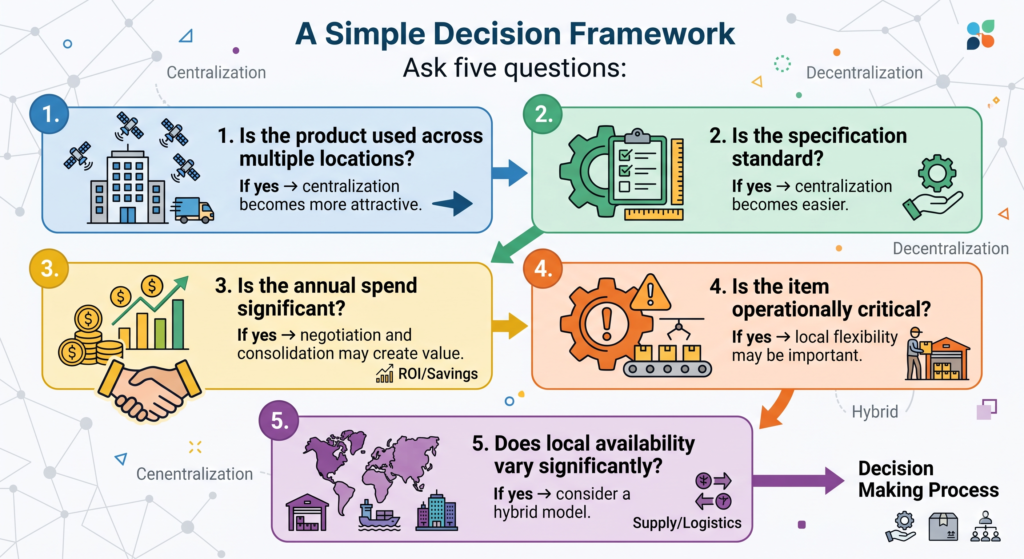
Centralized vs Decentralized: A Scoring Approach
A procurement team can score each category:
| Factor | Centralize if… |
|---|---|
| Spend | High |
| Volume | High |
| Specification | Standard |
| Supplier market | Competitive |
| Locations | Multiple |
| Demand | Predictable |
| Emergency requirement | Low |
| Local variation | Low |
The more boxes that are checked, the stronger the case for centralized procurement.
What About Multi-Location Companies?
This is where technology becomes increasingly important.
A modern procurement system can allow:
Head Office
→ controls suppliers, prices and catalogue
while
Branch Offices
→ raise their own requirements and place orders.
The system can then provide central visibility into:
- What each branch purchased
- How much it spent
- Which supplier supplied it
- Which products were purchased
- Frequency of purchases
- Exceptions
- Delivery performance
This is essentially the bridge between centralized control and decentralized execution.
The Real Goal Isn’t Centralization
This is perhaps the most important point.
Procurement teams sometimes treat:
Centralization = Good
and
Decentralization = Bad
That is too simplistic.
The actual objective is:
Standardize where standardization creates value.
Decentralize where local flexibility creates value.
A ₹200 item doesn’t need a three-level approval workflow just because the company has a procurement policy.
At the same time, allowing 50 branches to independently negotiate 50 versions of the same A4 paper is unlikely to be efficient.
Recommended Model for Most Growing Companies
For a growing multi-location business, a sensible starting point is:
Centralize
Strategy + Standards + Suppliers + Pricing + Contracts + Data
Decentralize
Requisition + Routine Ordering + Delivery Coordination + Limited Emergency Purchases
Monitor
Spend + Compliance + Supplier Performance + Exceptions
This creates a controlled procurement ecosystem without turning procurement into bureaucracy.
Frequently Asked Questions
Is centralized procurement always cheaper?
No. Centralization can improve purchasing power, but transportation, local availability and administrative complexity must also be considered.
Is decentralized procurement faster?
Usually, especially for urgent local requirements. However, it can create inconsistent pricing and supplier fragmentation.
What is hybrid procurement?
A hybrid model combines centralized procurement strategy and supplier management with local ordering and execution.
Which model is better for a company with many branches?
A hybrid model is often practical because it combines central control with local flexibility.
Should every stationery item be centrally purchased?
No. High-volume, standardised categories are better candidates for centralization. Very low-value or location-specific items may be better handled locally.
Conclusion
Centralized and decentralized procurement are not competing philosophies where one must always win.
They are tools.
For office supplies, the best procurement model often depends on:
Spend + Volume + Standardization + Location + Urgency + Supplier Availability.
Centralization can deliver better pricing, stronger supplier control, standardization and visibility.
Decentralization can deliver speed, flexibility and local responsiveness.
For many multi-location businesses, the sweet spot is hybrid procurement:
Centralize the strategy.
Empower the locations.
Control the exceptions.
Measure the results.
That is how procurement can move from simply buying office supplies to actually managing organizational spend intelligently.

Recent Comments