
No products in the cart.
Introduction
Every procurement team knows the conversation:
“Supplier A is ₹10 cheaper. Why are we buying from Supplier B?”
On paper, it sounds like an easy decision.
But procurement is rarely that simple.
A cheaper product can sometimes lead to higher consumption, more wastage, frequent replacements, operational delays, employee time spent resolving issues, or emergency purchases.
That means the purchase price is only one part of the actual cost.
For office supplies, this is particularly important because many products are low-value individually but purchased and consumed in large quantities.
A difference of ₹10 on one purchase may look insignificant.
Across thousands of units and hundreds of purchase orders, it can become substantial.
The better question for procurement teams is therefore not:
“Which supplier has the lowest price?”
It is:
“Which option gives us the lowest total cost for the required level of quality and service?”
What Is the Hidden Cost of Office Supplies?
The hidden cost is everything you spend beyond the invoice value to purchase, use, manage, replace and replenish a product.
A simple way to think about it is:
Total Cost = Purchase Cost + Usage Cost + Wastage + Process Cost + Downtime + Replacement Cost
Not every component will apply to every product.
But for many office supplies, looking only at the purchase price gives an incomplete picture.
1. The Cheapest Product May Not Be the Cheapest Per Use
Consider a simple example.
Suppose two products are available:
| Product A | Product B | |
|---|---|---|
| Purchase Price | ₹100 | ₹115 |
| Expected Usage | 100 units | 130 units |
| Effective Cost per Use | ₹1.00 | ₹0.88 |
Product B costs more at the time of purchase.
But if it lasts significantly longer, the cost per use may actually be lower.
This principle applies across procurement.
Instead of asking only:
“What is the price?”
also ask:
“How much output do I get for that price?”
2. Copier Paper: A Simple Example
Suppose an office buys two types of copier paper.
One costs ₹190 per ream.
Another costs ₹205.
The ₹190 option looks cheaper.
But imagine that the cheaper paper experiences more wastage, feeding issues or inconsistent printing in that particular office environment.
Even a small amount of additional wastage across hundreds of reams can reduce the apparent saving.
That doesn’t mean the ₹205 paper is automatically better.
It means the procurement decision should be based on actual performance, not price alone.
For paper, factors such as GSM, opacity, moisture, smoothness, printer compatibility and storage conditions can all influence the user experience.
3. The Cost of Wastage
Wastage is one of the easiest hidden costs to overlook.
Consider:
- Damaged stationery
- Misprinted documents
- Rejected labels
- Defective packaging
- Unused cleaning products
- Incorrectly ordered items
- Expired or deteriorated stock
If a ₹500 purchase results in ₹50 of avoidable wastage, the real cost isn’t ₹500.
It is closer to:
₹500 + ₹50 wastage = ₹550
And that’s before considering the time spent handling the problem.
4. Employee Time Is a Cost Too
This is probably one of the most overlooked procurement costs.
Imagine an office where stationery frequently runs out.
Someone has to:
- Notice the shortage
- Contact the supplier
- Request a quotation
- Compare prices
- Get approval
- Place the order
- Follow up
- Receive the goods
- Check the delivery
- Resolve discrepancies
The product itself might cost only ₹1,000.
But several hours of administrative effort may have been spent managing it.
Employee time has an economic value.
A procurement system that reduces unnecessary administrative work can therefore create savings even when the product price itself doesn’t change dramatically.
5. Stockouts Create Their Own Cost
A product being cheap doesn’t help if it isn’t available when you need it.
Imagine an office running out of printer paper at 4 PM before an important client presentation.
The procurement team now has limited options:
Normal purchase
→ Planned price
→ Normal delivery
→ Better supplier choice
versus
Emergency purchase
→ Limited supplier options
→ Potentially higher price
→ Delivery charges
→ Expedited logistics
→ More internal coordination
The original low-cost procurement strategy may suddenly become an expensive emergency.
6. Poor Quality Can Increase Consumption
Sometimes the problem isn’t that a product fails completely.
It simply gets consumed faster.
For example:
A cleaning product with a lower purchase price may require a larger quantity per application than a more concentrated alternative.
So comparing:
₹200 per bottle
versus
₹300 per bottle
doesn’t tell you enough.
You need to compare:
Cost per usable application
or
Cost per litre after dilution
or another relevant unit of consumption.
The same principle applies to many consumables.
7. Replacement Cost
A product that needs frequent replacement can quietly become expensive.
Consider an office accessory that costs ₹500 but lasts six months.
Another costs ₹750 but lasts eighteen months.
The second product has a higher purchase price.
But its annualized cost could be considerably lower.
This is why procurement teams should consider expected useful life, particularly for products that are repeatedly purchased.
8. Downtime Has a Cost
Some procurement failures have a disproportionately large operational impact.
A ₹300 consumable may stop a ₹10 lakh piece of equipment from functioning properly.
A missing packaging material may delay dispatch.
A printer consumable may prevent an entire department from completing urgent documentation.
The product itself may be inexpensive.
The consequence of not having the right product at the right time may not be.
This is why critical supplies should not always be evaluated using the same procurement criteria as ordinary consumables.
9. Delivery Reliability Matters
Two suppliers may offer the same price.
Supplier A usually delivers within 24–48 hours.
Supplier B frequently takes five to seven days.
Which one is cheaper?
The answer depends on your inventory and operational requirements.
If you need to maintain a much larger safety stock because Supplier B is unreliable, part of that additional inventory requirement is effectively a cost of choosing Supplier B.
Supplier reliability therefore has economic value.
10. The Cost of Incorrect Orders
Cheap procurement can become expensive when products are purchased without considering actual requirements.
Examples:
- Wrong GSM
- Wrong size
- Wrong cartridge model
- Wrong file size
- Wrong label dimensions
- Wrong packaging specification
- Wrong quantity
The invoice may have looked attractive.
But if the product cannot be used, the procurement saving disappears very quickly.
Before comparing prices, make sure you’re comparing equivalent specifications.
11. Supplier Service Is Also Part of Value
A supplier isn’t just an invoice.
You may also be buying:
- Availability
- Delivery reliability
- Order accuracy
- Responsiveness
- Replacement support
- Documentation
- Product knowledge
- Problem resolution
Two suppliers selling the same product at almost the same price may therefore provide very different overall value.
This is especially relevant for corporate procurement, where reliability often matters more than saving a few rupees on an individual SKU.
Total Cost of Ownership: A Better Way to Think
Procurement teams can use a simple framework:
1. Purchase Cost
What did we pay?
2. Usage Cost
How much product do we actually consume?
3. Wastage
How much is lost, damaged or rejected?
4. Process Cost
How much employee/admin time is required to manage it?
5. Downtime Cost
What happens if the product isn’t available or doesn’t work properly?
6. Replacement Cost
How frequently does it need to be replaced?
7. Logistics Cost
What does delivery, freight or emergency replenishment add?
This is the basic thinking behind Total Cost of Ownership (TCO).
A Simple Example
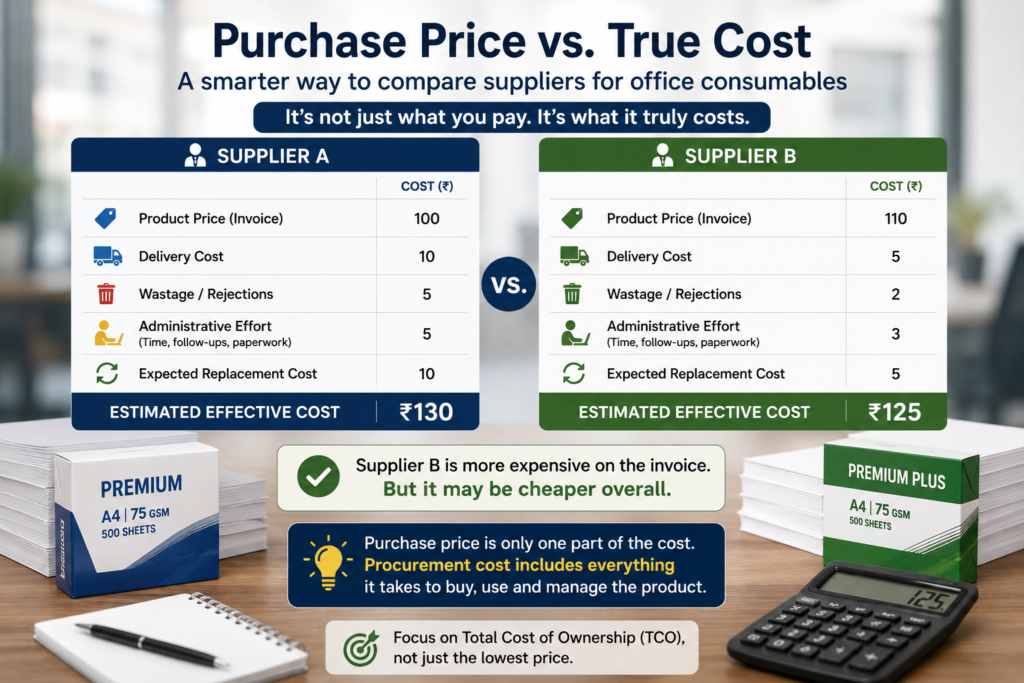
When Should You Actually Choose the Cheapest Product?
This is important.
The answer isn’t:
“Never buy the cheapest product.”
That would be equally bad procurement.
If two products have:
- Equivalent specifications
- Similar quality
- Similar reliability
- Similar availability
- Similar supplier service
- Similar expected life
then buying the cheaper option makes perfect sense.
Procurement should not use “Total Cost of Ownership” as an excuse to justify expensive products.
The objective is not:
Buy expensive.
The objective is:
Buy the right product at the lowest sustainable total cost.
A Practical Supplier Scorecard
Instead of evaluating suppliers only on price, procurement teams can create a simple scorecard.
| Factor | Suggested Weight |
|---|---|
| Price | 30% |
| Quality | 20% |
| Reliability | 15% |
| Availability | 15% |
| Supplier Service | 10% |
| Delivery Performance | 10% |
These weights aren’t universal.
For a critical production item, reliability might deserve a much higher weight.
For a commodity stationery item, price may reasonably receive more weight.
The important thing is to define the criteria before making the decision.
5 Questions to Ask Before Choosing the Cheapest Supplier
Before placing the order, ask:
1. Are we comparing identical specifications?
A lower price isn’t meaningful if the product is different.
2. What is the cost per actual use?
Look beyond the unit price.
3. How much wastage should we expect?
A small percentage can become significant at scale.
4. What happens if the supplier doesn’t deliver?
Consider operational and emergency procurement costs.
5. How much internal effort will this supplier require?
A supplier who constantly needs follow-ups isn’t necessarily the lowest-cost supplier.
The 80/20 Approach to Procurement
Not every office supply needs a complicated TCO analysis.
That would itself create unnecessary administrative cost.
Instead, identify the categories where a deeper analysis can actually make a difference.
High-volume consumables
Examples:
- Copier paper
- Toners
- Packaging materials
- Cleaning supplies
Operationally critical items
Products where stockouts can disrupt operations.
Frequently purchased products
Even a small saving per unit can become meaningful at high volumes.
Products with significant quality variation
Where a cheaper product may have materially different performance.
For low-value, low-risk items, simple price comparison may be perfectly adequate.
Good procurement is proportionate procurement.
The Real Meaning of “Cost Saving”
There is an important difference between:
Price Reduction
“We negotiated ₹10 less per unit.”
and
Cost Reduction
“We reduced the total cost of obtaining and using the product.”
The second is the more meaningful procurement achievement.
Sometimes the best procurement decision may actually involve paying a slightly higher unit price to achieve:
- Lower consumption
- Lower wastage
- Better reliability
- Fewer stockouts
- Less administrative work
- Better supplier performance
A Better Procurement Mindset
Instead of asking:
“Can we get this cheaper?”
ask:
“Can we get the same outcome at a lower total cost?”
That small change in thinking can significantly improve procurement decisions.
It shifts the conversation from price negotiation to value creation.
Frequently Asked Questions
Is the cheapest supplier always the best supplier?
No. The cheapest supplier is the best choice only when the lower price does not create additional costs through quality, reliability, delivery, wastage or other factors.
What is Total Cost of Ownership in procurement?
TCO is the broader cost of acquiring, using and maintaining a product or service rather than looking only at its purchase price.
How can procurement teams calculate hidden costs?
Start with purchase price and add relevant costs such as delivery, consumption, wastage, employee processing time, replacement, downtime and emergency procurement.
Should every office supply undergo TCO analysis?
No. Detailed analysis should be reserved for high-volume, high-value, high-risk or operationally important categories. For low-value commodities, simple price comparison may be sufficient.
Is a higher-priced product always better?
Absolutely not. Higher price does not automatically mean higher quality or lower TCO. Products should be compared against specifications, performance and actual usage.
Conclusion
The cheapest product isn’t necessarily expensive.
And the expensive product isn’t necessarily better.
The real mistake is assuming that the invoice price tells you the complete cost.
For procurement teams, the smarter approach is to consider what happens after the purchase:
How much is consumed?
How much is wasted?
How reliable is the supplier?
How much employee time is involved?
What happens during a stockout?
How often does the product need replacement?
When these questions are considered together, procurement becomes more than a process of finding the lowest quotation.
It becomes a process of optimising total business cost.
The best procurement decision isn’t:
“Buy the cheapest.”
It is:
“Buy the right product, from the right supplier, at the lowest total cost.”

Recent Comments