
No products in the cart.
Managing stationery for one office is easy.
Managing stationery for 10, 50 or 100 branches across different cities is a completely different challenge.
A branch needs A4 paper. Another needs files and folders. Another needs pens, registers and markers. Someone needs printer consumables. The housekeeping team needs cleaning supplies.
At the same time, the central procurement team wants:
- Consistent pricing
- Standardized products
- Reliable delivery
- Proper GST documentation
- Branch-wise visibility
- Fewer vendors
- Less administrative work
This is where traditional stationery procurement starts becoming inefficient.
For companies with multiple branches, one of the most effective approaches is to move towards centralized office stationery procurement with branch-wise fulfilment.
Instead of every branch independently finding and managing stationery vendors, the organization establishes a common procurement process while allowing supplies to be delivered directly to the required branch.
This article explains how that model works, what companies should consider, and how a procurement platform such as Yostodesk can fit into the process.
What Is Multi-Branch Office Stationery Procurement?
Multi-branch stationery procurement means managing the purchase and supply of office stationery for multiple offices, branches, stores, warehouses or other business locations under one organizational procurement framework.
For example, a company may have offices in:
Mumbai → Pune → Delhi → Bengaluru → Hyderabad → Chennai → Ahmedabad → Kolkata
Each location has its own requirements, but the company may still want central control over:
- Products
- Pricing
- Vendors
- Approvals
- Ordering
- Billing
- Delivery
- Spending
The challenge is finding the right balance between centralized control and local convenience.
Why Does Stationery Procurement Become Difficult as Branches Increase?
A company with one office may simply call a nearby stationery supplier.
With multiple branches, the same approach creates fragmentation.
A typical decentralized model looks like this:
Branch → Local Vendor → Order → Delivery → Invoice → Payment
Now imagine repeating this process across 30 branches.
The company may end up with:
- Dozens of stationery vendors
- Different prices for identical products
- Different brands and specifications
- Different delivery practices
- Multiple invoices
- Multiple payment terms
- Repeated vendor negotiations
- Difficult reconciliation
- Limited visibility for central procurement
The stationery itself is not complicated.
Managing hundreds of small procurement transactions is.
What Is the Best Way to Supply Stationery to Multiple Branches?
For many multi-location organizations, a practical model is:
Centralized Procurement + Decentralized Delivery
The company manages the procurement framework centrally, while stationery is supplied directly to individual branches.
The basic process looks like this:
Company defines requirements
↓
Approved catalogue & commercial terms
↓
Branch raises requirement
↓
Approval, where applicable
↓
Order processing
↓
Direct delivery to branch
↓
Central procurement gets visibility
This model removes much of the unnecessary vendor coordination at the branch level without forcing every stationery requirement to pass manually through the head office.
1. Create a Standard Office Stationery Catalogue
The first step is to decide what employees and branches should normally purchase.
Instead of allowing every branch to buy any product available in the market, companies can create an approved catalogue.
For example:
| Category | Examples |
|---|---|
| Writing | Ball pens, gel pens, markers |
| Paper | A4, A3, copier paper |
| Filing | Files, folders, binders |
| Desk Supplies | Staplers, punches, clips |
| Registers | Registers, notebooks, writing pads |
| Printing | Toners, cartridges |
| Packaging | Tapes, envelopes, boxes |
| Housekeeping | Cleaning and washroom supplies |
This creates a common product language across the organization.
Instead of:
“Please buy a good A4 paper.”
the requirement becomes:
“Order the approved A4 paper from the company catalogue.”
That small change can make procurement much easier to control.
2. Standardize Frequently Purchased Products
Product standardization is particularly useful for products that are purchased repeatedly.
For example, if 40 branches use A4 paper, the organization can identify an approved product or specification.
The same principle can apply to:
- Pens
- Markers
- Files
- Folders
- Registers
- Envelopes
- Printer consumables
- Packaging materials
- Housekeeping products
Standardization can help businesses achieve:
Better consistency + easier procurement + simpler comparison
However, standardization should not become rigid bureaucracy.
If a branch has a genuine local requirement, the procurement process should allow an approved exception.
3. Negotiate Commercial Terms Centrally
One of the strongest reasons to centralize procurement is purchasing power.
If 30 branches independently buy the same products, the company may have limited visibility into the overall volume.
A centralized procurement team can look at the organization’s combined requirements.
Instead of asking:
“What is the price for one branch?”
the organization can ask:
“What commercial terms can we obtain based on our overall business requirement?”
Depending on the products and volumes, this can help with:
- Better pricing
- Consistent rates
- Defined delivery terms
- Agreed payment terms
- Better supplier accountability
However, companies should compare total delivered cost, not just the product’s listed price.
4. Allow Branch-Wise Ordering
Centralization should not mean that every branch has to email the head office whenever it needs stationery.
That simply moves the bottleneck from the vendor to the procurement department.
A better approach is to allow authorized employees or branch users to raise their requirements through a structured system.
For example:
Branch Employee
→ Selects required products
→ Enters quantity
→ Selects branch/location
→ Submits requirement
→ Approval, if required
→ Order fulfilment
This gives branches convenience while maintaining organizational control.
5. Deliver Directly to the Required Branch
This is one of the most important parts of a multi-location supply model.
Suppose the central procurement team places an order for:
- Mumbai
- Pune
- Delhi
- Bengaluru
- Hyderabad
There is little benefit in sending everything to the head office first and then redistributing it.
A more efficient model can be:
Centralized ordering
but
Direct-to-branch delivery
For example:
Central Procurement
↓
Supplier / Fulfilment Network
↓
Mumbai Branch
Pune Branch
Delhi Branch
Bengaluru Branch
Hyderabad Branch
This can eliminate an unnecessary handling and transportation step.
6. Define Clear Approval Rules
Not every stationery order needs the same level of approval.
A company could establish rules based on:
- Order value
- Product category
- Quantity
- Employee role
- Branch
- Frequency
For example:
Routine requirement
An approved product within the branch’s permitted limit may move through a simple approval process.
High-value requirement
An order above a defined threshold may require manager or procurement approval.
Non-standard requirement
A product outside the approved catalogue may require procurement approval.
The objective is:
Control the purchase without slowing down the business.
7. Maintain Visibility Across Branches
This is where a structured procurement system becomes significantly more useful than scattered emails and WhatsApp messages.
Central procurement should ideally be able to understand:
- Which branch ordered what
- How frequently it orders
- How much it spends
- Which products are being consumed
- Which branches have unusually high consumption
- Which products are most frequently purchased
- Whether branches are purchasing outside the approved catalogue
This data can help procurement teams identify opportunities for:
Standardization → Negotiation → Cost control
8. Make Billing and Documentation Structured
Multiple branches can create complicated billing requirements.
Before onboarding a supplier, companies should clearly define:
- Billing entity
- Delivery location
- GST details
- Purchase order requirements
- Invoice requirements
- Branch-wise allocation
- Payment terms
- Returns and credit notes
A good procurement process should make it clear who is buying, where the goods are being delivered, and how the transaction will be accounted for.
This becomes increasingly important as the number of branches grows.
9. Define Minimum Order and Delivery Conditions
“PAN India supply” sounds attractive, but businesses should ask practical questions.
For example:
- Is there a minimum order value?
- Is MOQ applicable?
- Does MOQ differ by product?
- Does MOQ differ by location?
- Are shipping charges applicable below a threshold?
- What is the expected delivery timeline?
- Are all products available across all locations?
These details matter much more than simply knowing that a supplier claims to deliver across India.
10. Plan for Emergency Requirements
Stationery procurement cannot always operate like a perfectly predictable monthly plan.
A branch may suddenly run out of:
- A4 paper
- Toner
- Printer labels
- Packaging tape
- Essential stationery
- Cleaning supplies
Therefore, a good procurement model should have a mechanism for handling urgent requirements.
Companies can consider:
- Minimum branch stock levels
- Buffer stock for frequently used products
- Emergency ordering procedures
- Approved local exceptions
- Defined service levels
The objective is not to eliminate every local purchase.
The objective is to reduce unnecessary local purchases while keeping the business operational.
Centralized vs Local Stationery Procurement
Both models have advantages.
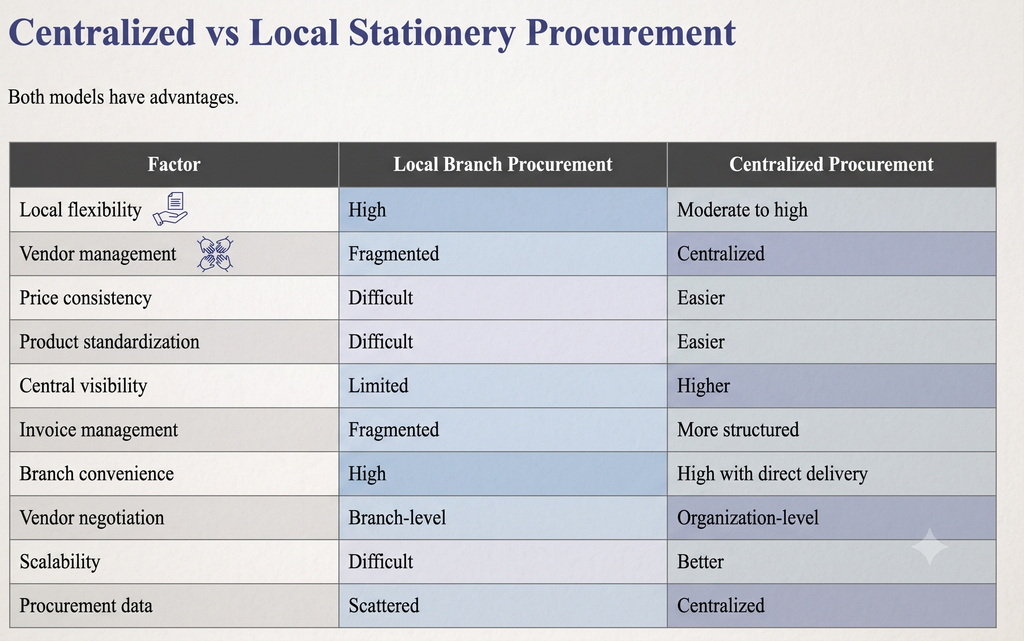
There is no rule that says every company must use one supplier.
The better approach is to identify which categories and locations can be effectively centralized.
Should a Company Use One Stationery Vendor for Every Branch?
Not necessarily.
This is an important point.
Vendor consolidation can be useful, but blindly forcing every product through one supplier can create its own risks.
Companies should evaluate:
- Geographic coverage
- Product availability
- Pricing
- Quality
- Delivery performance
- MOQ
- Service capability
- Replacement process
- Payment terms
- Category expertise
For some categories, one supplier may be ideal.
For others, maintaining multiple approved suppliers may be sensible.
The objective should be:
Simplified and controlled procurement — not simply fewer vendor names.
The Hidden Cost of Decentralized Stationery Procurement
The price of a pen, file or paper ream is not the complete cost of procurement.
Consider a ₹1,000 stationery requirement.
Someone has to:
- Identify the requirement
- Find a supplier
- Ask for the price
- Compare the price
- Obtain approval
- Place the order
- Follow up
- Receive the goods
- Check the invoice
- Process the payment
Now multiply that process by hundreds or thousands of transactions.
The administrative cost can become much larger than the stationery value itself.
This is why procurement process efficiency matters.
How Yostodesk Fits Into Multi-Branch Stationery Procurement
Yostodesk is built around a simple business problem:
How can companies manage recurring office-supplies requirements across multiple locations without making every branch manage its own procurement?
For a company onboarding Yostodesk, the procurement framework can be structured around its organizational requirements, locations and supply model.
This can include:
Company-level procurement
A company can establish its overall office-supplies requirements and commercial framework.
Multiple locations
Branches and offices can be mapped according to the organization’s supply requirements.
Approved products
The organization can define the products and categories that employees or branches should procure.
Branch-wise fulfilment
Requirements can be fulfilled for the relevant location instead of unnecessarily routing every shipment through the head office.
Centralized relationship
Instead of every branch independently managing multiple stationery suppliers, the organization can work through a more structured procurement relationship.
The exact operating model can be configured according to the organization’s PAN India, regional or local supply requirements.
Example: How a 50-Branch Company Could Structure Procurement
Consider a company with 50 branches across India.
Traditional model
50 branches
↓
Multiple local vendors
↓
Different products
↓
Different prices
↓
Different invoices
↓
Central team manually reconciles everything
Structured model
50 branches
↓
Yostodesk procurement system
↓
Approved products & commercial terms
↓
Branch-wise requirements
↓
Location-specific fulfilment
↓
Central procurement visibility
The difference isn’t merely about buying stationery online.
It is about changing how the organization manages the procurement process.
A Practical Checklist for Multi-Branch Stationery Procurement
Before selecting a stationery supply partner, ask:
Product
- Does the supplier have the products we regularly need?
- Can preferred products be standardized?
- Can alternatives be approved when products are unavailable?
Pricing
- Are rates consistent?
- Can pricing be negotiated based on overall requirements?
- Are delivery charges clearly defined?
Locations
- Which cities and locations can be served?
- Can products be delivered directly to branches?
- Are there location-specific restrictions?
Operations
- How are orders placed?
- Can branches raise requirements?
- Is an approval workflow possible?
- How are urgent requirements handled?
Documentation
- Are GST invoices provided?
- Can billing and delivery locations be clearly identified?
- Can purchase orders be accommodated?
Service
- What are the expected delivery timelines?
- How are damaged or incorrect products handled?
- Who is responsible for resolving delivery issues?
Commercials
- Is there an MOQ?
- Is there a minimum order value?
- What payment terms are available?
- Can recurring requirements be managed?
When Should a Company Consider Centralized Stationery Procurement?
Centralized procurement becomes particularly useful when a company has:
- Multiple offices or branches
- Locations across different cities
- Frequent stationery requirements
- Several local stationery vendors
- Different prices for identical products
- Difficulty tracking branch-wise spending
- High procurement administration
- A need for standardized products
- A centralized Purchase, Admin or Facility team
For a small company with one office, this may be unnecessary.
For a company operating across dozens of locations, it can significantly simplify day-to-day procurement.
Final Takeaway
The best way to supply office stationery to multiple branches is not necessarily to find the cheapest stationery supplier.
It is to create a procurement model that combines:
Centralized procurement
Standardized products
Agreed commercial terms
Branch-wise ordering
Direct-to-location delivery
Approval controls
Central visibility
Reliable fulfilment
The goal is simple:
Branches should get what they need, while the organization retains control over what is being purchased, from whom, at what price and where it is being delivered.
As companies expand from one office to multiple branches and cities, stationery procurement needs to evolve with them.
What worked for five branches may not work for fifty.
And what works for fifty may need an entirely different system at one hundred.
Looking for a Better Way to Manage Multi-Branch Office Supplies?
Yostodesk helps businesses structure and manage office-supplies procurement for their offices, branches and locations.
Whether your requirement is PAN India, regional or local, the right procurement model can be designed around your locations, products, approval requirements and supply needs.
If your organization is currently managing stationery through multiple local vendors, spreadsheets, emails and WhatsApp messages, it may be worth evaluating whether a more centralized procurement approach can reduce the operational workload.
Talk to Yostodesk about your multi-location office-supplies requirements.

Recent Comments