
No products in the cart.
Introduction
Office supplies are often treated as a small administrative expense.
A few reams of paper.
Some pens.
Files and folders.
Printer consumables.
Cleaning materials.
Packaging supplies.
Individually, these purchases may not look significant.
But across multiple departments, branches and months, they can create substantial procurement spend—and even more administrative work.
Table of Contents
This is where a simple Office Supplies Procurement Policy can make a big difference.
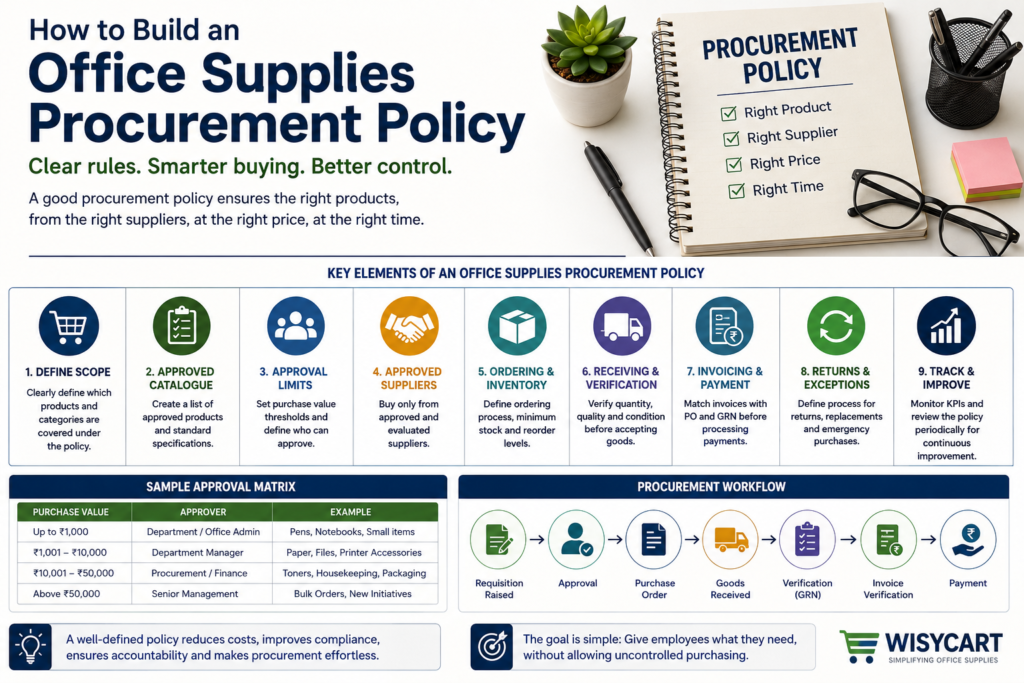
A good policy does not mean creating paperwork for every pen or stapler.
It means creating clear rules around:
- What employees can request
- Who can approve it
- Which products should be standardized
- Which suppliers can be used
- What spending limits apply
- When exceptions are allowed
- How purchases should be tracked
The objective is simple:
Give employees what they need without allowing uncontrolled purchasing.
What Is an Office Supplies Procurement Policy?
An office supplies procurement policy is a set of rules that defines how an organisation purchases, approves, receives and manages office supplies.
It typically covers products such as:
- Copier paper
- Pens and writing instruments
- Files and folders
- Printer consumables
- Desk accessories
- Housekeeping supplies
- Packaging materials
- Office electronics and accessories
The exact scope should depend on the organisation.
A 20-person office does not need the same procurement policy as a company operating 100 branches.
Why Do Companies Need One?
Without a defined process, office supplies often become a classic example of maverick buying.
One employee orders from one supplier.
Another employee buys from a local shop.
A branch uses a different brand.
Someone purchases urgently because stock has run out.
Another department keeps excess inventory “just in case.”
Individually, none of these decisions looks serious.
Collectively, they create:
Higher prices + duplicate purchases + inconsistent products + poor visibility + administrative workload.
A procurement policy brings some structure to the chaos.
1. Start by Defining What Is Covered
The first step is surprisingly important:
Define the scope.
For example:
Office Consumables
- A4 paper
- Notebooks
- Pens
- Markers
- Files
- Folders
- Envelopes
Printing Supplies
- Toners
- Ink cartridges
- Labels
- Specialty paper
Housekeeping
- Cleaning chemicals
- Tissue products
- Garbage bags
- Cleaning tools
Packaging
- Corrugated boxes
- Tapes
- Stretch film
- Packaging accessories
You can also create separate policies for categories that require technical, regulatory or security considerations.
2. Create an Approved Product Catalogue
This can be one of the most effective controls.
Instead of allowing employees to search for any product they want, create an approved catalogue.
For example:
Copier Paper
Standard: 75 GSM
Premium: 80 GSM
Pens
Standard: Blue ball pen
Premium: Gel pen
Files
Standard: A4 plastic file
Alternative: A4 paper file
The catalogue doesn’t need to eliminate all choice.
It simply ensures that commonly purchased products have pre-approved specifications and alternatives.
3. Define Standard Specifications
“Buy A4 paper” isn’t necessarily a complete specification.
A procurement specification may need to consider:
- Size
- GSM
- Brightness
- Opacity
- Required certification
- Printer compatibility
- Packaging
- Brand requirements, where justified
Similarly, for other products:
Toner: Printer model + cartridge specification
Cleaning chemical: Product type + concentration/use requirement
Packaging box: Length × width × height + board specification
The more important the product, the more carefully its specification should be defined.
4. Set Approval Limits
Not every purchase should require the Procurement Head’s approval.
That creates bureaucracy.
Instead, establish approval thresholds.
For example:
| Purchase Value | Suggested Approval |
|---|---|
| Up to ₹1,000 | Department/Office Admin |
| ₹1,001–₹10,000 | Department Manager |
| ₹10,001–₹50,000 | Procurement / Finance |
| Above ₹50,000 | Senior Management |
These numbers are only illustrative.
Each organisation should establish limits based on its size, risk profile and purchasing pattern.
The principle is:
Low-value routine purchases should move quickly. High-value or unusual purchases should receive greater scrutiny.
5. Define Who Can Purchase
A policy should clearly answer:
Who is authorised to buy office supplies?
Possible structures include:
Model A — Central Procurement
Only the central procurement team places orders.
Model B — Departmental Buying
Departments can purchase within approved limits.
Model C — Hybrid
Central procurement manages suppliers and pricing while departments raise requirements and place approved orders through a catalogue.
For multi-location organisations, the hybrid model can often provide a useful balance between control and speed.
6. Establish Approved Suppliers
A procurement policy should ideally define how suppliers are approved.
Consider:
- Product quality
- Pricing
- Delivery capability
- Geographic coverage
- GST documentation
- Payment terms
- Return/replacement policy
- Service responsiveness
- Relevant certifications
- Track record
Don’t select suppliers only because they offer the lowest quotation.
As we discussed in our earlier article:
The cheapest invoice is not necessarily the lowest total cost.
7. Create Rules for New Suppliers
Employees should not be able to add a new supplier simply because:
“They were ₹50 cheaper.”
Define a simple supplier onboarding process.
For example:
Employee Request
↓
Procurement Review
↓
Commercial & Compliance Check
↓
Supplier Approval
↓
Vendor Creation
↓
First Order
This prevents uncontrolled supplier proliferation.
8. Define Emergency Purchases
Every procurement policy needs an emergency provision.
Because emergencies happen.
A printer runs out of toner before an important meeting.
A branch runs out of packaging material.
A cleaning product becomes unavailable.
The mistake is trying to eliminate emergency buying altogether.
Instead, define:
- What qualifies as an emergency
- Who can approve it
- Maximum emergency purchase value
- Which suppliers can be used
- How the purchase must be reported afterward
A good policy allows exceptions without turning exceptions into the normal process.
9. Set Inventory & Reorder Rules
Procurement and inventory are closely connected.
For frequently used products, define:
Minimum Stock
The lowest acceptable inventory level.
Reorder Point
The level at which a new order should be triggered.
Maximum Stock
The level beyond which additional purchasing should normally be avoided.
For example:
Monthly consumption: 500 reams
Safety stock: 200 reams
Reorder point: 250 reams
The actual calculation should consider supplier lead time and demand variability.
The important point is to avoid both:
Stockout
and
Overstock.
10. Create a Purchase Requisition Process
Employees should have a simple way to request supplies.
A basic requisition could contain:
- Employee/department
- Location
- Product
- Quantity
- Required date
- Reason, where applicable
- Approver
For standard catalogue products, employees shouldn’t have to manually enter every technical detail.
They should simply select:
A4 Copier Paper — Standard — 20 Reams
The procurement system can already contain the relevant product specification.
11. Separate “Need” From “Preference”
This is a subtle but useful procurement control.
An employee may request:
“Brand X premium notebook.”
But the actual requirement may simply be:
“A notebook for internal meeting notes.”
The procurement team should distinguish between:
Business Requirement
and
Personal Preference.
Brand-specific purchasing can be justified where quality, compatibility, standardization or another legitimate business reason exists.
Otherwise, unnecessary brand restrictions can increase cost.
12. Define Receiving & GRN Procedures
Procurement doesn’t end when the supplier delivers the carton.
Someone should verify:
- Quantity
- Product
- Condition
- Packaging
- Damage
- Specification
- Invoice/delivery challan
For larger organisations, the receiving process should generate a Goods Receipt Note (GRN) or equivalent record.
This creates a clear chain:
Request → Approval → Purchase Order → Delivery → GRN → Invoice → Payment
That chain is important for both procurement control and finance reconciliation.
13. Define Returns and Replacements
The policy should also answer:
What happens when the wrong product arrives?
or:
What happens when the product is damaged?
Define:
- Who reports the issue
- Evidence required
- Supplier response timeline
- Replacement process
- Credit-note process
- Escalation procedure
Without a defined process, small discrepancies can remain unresolved for weeks.
14. Track Procurement KPIs
A procurement policy should not simply create rules.
It should create measurable outcomes.
Useful KPIs include:
Purchase Price Variance
Are actual purchase prices moving against negotiated rates?
Supplier On-Time Delivery
Are suppliers delivering when promised?
Order Accuracy
How often are orders delivered correctly?
Stockout Rate
How often does the organisation run out of critical supplies?
Maverick Spend
How much purchasing happens outside approved suppliers or processes?
Procurement Cycle Time
How long does it take from request to purchase?
Savings
How much measurable cost reduction has procurement generated?
15. Don’t Overcomplicate the Policy
This may be the most important rule.
A 50-page procurement policy for stationery can actually make procurement worse.
Employees will find ways around it.
Instead, create:
One clear policy
What are the rules?
One simple process
How do I buy something?
One approved catalogue
What can I buy?
One approval matrix
Who needs to approve it?
One exception process
What happens when the standard process doesn’t work?
That is usually more useful than a huge policy document nobody reads.
A Simple Office Supplies Procurement Workflow
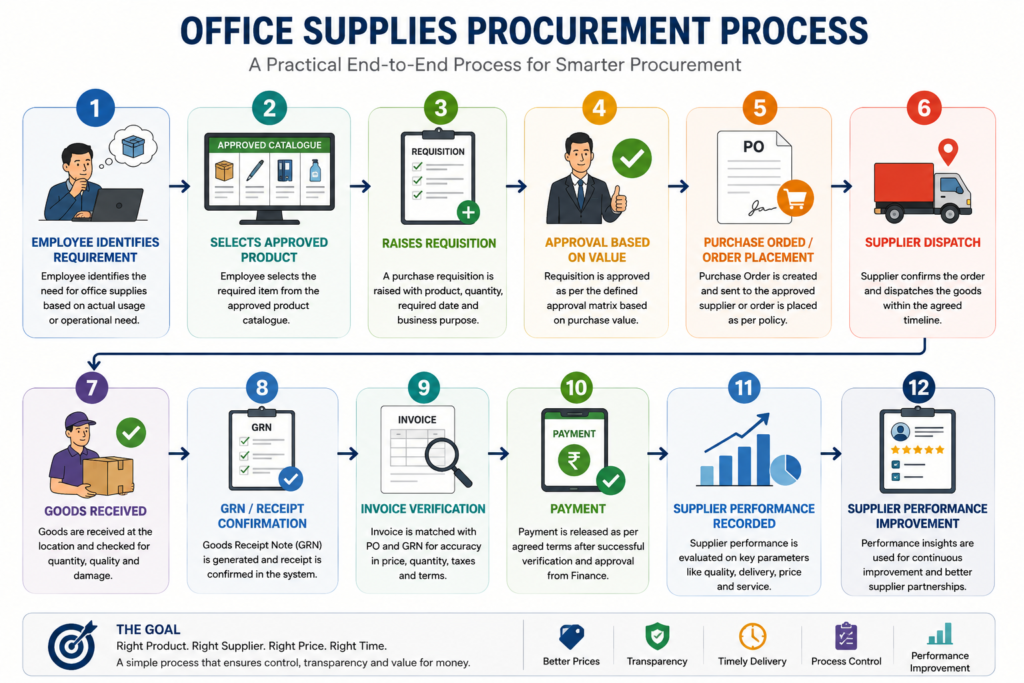
This creates accountability without making routine purchases unnecessarily complicated.
Centralized or Decentralized?
The policy should also clearly define the operating model.
For a multi-location organisation:
Central Procurement Controls
- Supplier contracts
- Negotiated pricing
- Product specifications
- Approved catalogue
- Supplier performance
- Procurement policy
Local Teams Handle
- Requisitions
- Routine ordering
- Delivery coordination
- Local requirements
- Approved emergency purchases
This is often more practical than trying to centralize every individual transaction.
How Technology Can Improve the Process
Once an organisation grows, email-based procurement becomes difficult to manage.
A procurement platform can provide:
- Digital requisitions
- Approval workflows
- Approved catalogues
- Location-wise ordering
- Supplier management
- Purchase history
- Spend analytics
- Inventory visibility
- Automated reminders
- Multi-location controls
The goal isn’t technology for its own sake.
The goal is to make the procurement policy easy to follow.
Because the best procurement policy is the one employees actually use.
Common Mistakes to Avoid
Mistake 1: Making every purchase require senior approval
This creates bottlenecks.
Mistake 2: Focusing only on price
Quality, delivery and reliability also matter.
Mistake 3: Allowing unlimited supplier additions
This fragments spend and reduces negotiating power.
Mistake 4: No emergency procurement process
People will simply bypass the policy.
Mistake 5: No approved product catalogue
Employees end up buying dozens of variations of the same product.
Mistake 6: Ignoring local requirements
Centralization without flexibility can become counterproductive.
Mistake 7: Creating a policy nobody can understand
If employees need a lawyer to interpret the stationery policy, the policy has failed.
Frequently Asked Questions
Does every company need a formal procurement policy for office supplies?
Not necessarily a lengthy formal document. Even a small company benefits from clearly defined purchasing, approval and supplier rules.
Who should own the policy?
Typically Procurement, Finance or Administration, depending on the organisation’s structure. In larger companies, these functions may jointly govern it.
Should employees be allowed to purchase office supplies directly?
They can be, within defined limits and from approved suppliers or catalogues.
How often should the policy be reviewed?
At least periodically, and whenever there is a major change in the organisation, supplier base, approval structure or procurement technology.
Is centralized procurement better?
Not always. A hybrid model often works well for multi-location businesses because it combines central control with local flexibility.
Conclusion
An office supplies procurement policy isn’t about making employees fill out forms before buying a pen.
It is about creating a repeatable, controlled and efficient way to meet everyday business requirements.
A good policy answers five basic questions:
What can we buy?
From whom can we buy it?
Who can approve it?
How should we buy it?
How do we know whether procurement is working?
For a small office, this may fit on a few pages.
For a multi-location organisation, it can become an important part of spend management and operational control.
The objective remains the same:
Make the right purchase, from the right supplier, at the right price, at the right time—with minimum unnecessary effort.

Recent Comments