
No products in the cart.
Every procurement professional has heard this request:
“Just get the lowest quote.”
It sounds logical.
After all, procurement is expected to save money.
But there is a problem with this approach:
The lowest purchase price is not always the lowest procurement cost.
A good procurement team doesn’t simply find the cheapest vendor.
It finds the best value for the business.
And there is a big difference.
The Hidden Cost of “Cheap”
Imagine two suppliers.
Supplier A
- Price: ₹100
- Delivery: 3 days
- Consistent quality
- Good communication
- Reliable replacement support
Supplier B
- Price: ₹90
- Delivery: Uncertain
- Inconsistent quality
- Poor communication
- Difficult replacement process
On a comparison sheet, Supplier B appears to save ₹10.
But procurement doesn’t end when the purchase order is issued.
What happens when:
❌ The delivery is delayed?
❌ The product doesn’t meet expectations?
❌ A replacement is required?
❌ Employees spend time chasing the supplier?
❌ A branch has to make an emergency purchase?
❌ Operations are disrupted?
That ₹10 saving can disappear very quickly.
Purchase Price Is Not Total Cost
This is where Total Cost of Ownership (TCO) becomes important.
The real cost of a purchase can include:
Purchase Price + Delivery + Wastage + Replacement + Administrative Effort + Downtime + Emergency Procurement
Not every cost applies to every product.
But the principle is important:
Don’t measure procurement savings only by what you paid the supplier. Measure what the purchase ultimately costs the business.
Procurement Has Evolved
Traditional procurement often focused heavily on:
✔ Lowest quotation
✔ Maximum discount
✔ Immediate price saving
Modern procurement increasingly looks beyond the invoice.
Procurement teams also consider:
✔ Total Cost of Ownership
✔ Supplier reliability
✔ Quality consistency
✔ Delivery performance
✔ Service levels
✔ Compliance
✔ Business continuity
✔ Supply risk
✔ Scalability
Because price is only one component of value.
A Simple Copier Paper Example
Consider copier paper.
Vendor A
₹250 per ream
Vendor B
₹235 per ream
At first glance:
Vendor B saves ₹15 per ream.
Now imagine that, in your particular application, Vendor B’s paper results in more:
- Paper wastage
- Feeding problems
- Replacements
- Stockouts
- Employee complaints
- Procurement follow-ups
The ₹15 saving may no longer be meaningful.
And importantly, this does not mean that the ₹250 paper is automatically better.
It means the procurement team should compare the actual performance and total cost, rather than assuming that the lowest invoice price represents the best deal.
The invoice may show savings. The operation may tell a different story.
The Cost of Employee Time
This is one of the most overlooked procurement costs.
Suppose a supplier repeatedly requires follow-ups.
Someone has to:
Call → Email → Follow up → Escalate → Reconcile → Replace
The product may be inexpensive.
But employee time isn’t free.
If a supplier saves ₹5 on an item but requires hours of additional administrative effort every month, the “saving” needs to be questioned.
Procurement should optimise people’s time as well as product prices.
The Cost of Stockouts
A low-cost supplier isn’t necessarily valuable if the product isn’t available when you need it.
Consider a branch that runs out of printer paper before an important meeting.
The business may now have to:
- Buy from a local supplier
- Pay a higher price
- Pay urgent delivery charges
- Accept whatever product is available
- Spend employee time arranging the purchase
The original procurement saving has suddenly become an operational expense.
Reliability has an economic value.
The Procurement Maturity Test
Here’s a simple test.
When evaluating a supplier, does your team consider:
- Quality consistency?
- Delivery performance?
- Order accuracy?
- Return and replacement handling?
- Supplier responsiveness?
- Geographic coverage?
- Product availability?
- Compliance?
- Total cost?
- Long-term scalability?
Or does the comparison sheet mainly contain:
Supplier | Price | Lowest Quote
If it is mostly the second, there may be an opportunity to mature the procurement process.
But Don’t Misunderstand This
There is an important caveat.
Higher price does not automatically mean better value.
And “Total Cost of Ownership” should not become an excuse to buy expensive products.
If two suppliers offer:
- Equivalent specifications
- Equivalent quality
- Similar delivery reliability
- Similar service
- Similar availability
then the cheaper supplier may very well be the better choice.
That’s exactly what good procurement should do.
Don’t pay more without a reason.
Instead:
Pay the right price for the right level of quality, reliability and service.
A Better Supplier Evaluation Model
Instead of evaluating suppliers only on price, procurement teams can use a simple scorecard.
| Factor | Example Weight |
|---|---|
| Price | 30% |
| Quality | 20% |
| Delivery | 15% |
| Reliability | 15% |
| Service | 10% |
| Compliance & Risk | 10% |
These weights are only illustrative.
A critical production item may require much greater emphasis on reliability.
A standard stationery item may justify a much greater emphasis on price.
The weight should reflect the business impact of failure.
Ask These 5 Questions Before Choosing the Cheapest Vendor
1. Are we comparing equivalent products?
A cheaper quote isn’t meaningful if the specifications are different.
2. What is the expected cost per use?
Look beyond the unit price.
3. What happens if something goes wrong?
Consider replacement, downtime and employee effort.
4. Can the supplier consistently deliver?
A good price is of limited value if availability is unreliable.
5. What will this relationship cost us to manage?
A supplier requiring constant follow-up may not be as inexpensive as the quotation suggests.
The Last 2% Can Sometimes Cost You More
Procurement teams are often under pressure to squeeze out the final few percentage points.
That’s understandable.
But there is a point where chasing another 2% discount can create disproportionate operational risk.
Saving ₹2 lakh on purchase price doesn’t look impressive if it subsequently creates:
- ₹1 lakh in wastage
- ₹50,000 in emergency purchases
- Additional administrative workload
- Operational delays
- Supplier disputes
The objective isn’t to win the negotiation.
The objective is to improve the economics of the business.
What Good Procurement Leaders Actually Ask
They don’t stop at:
“Who is cheapest?”
They ask:
“What will this purchase really cost us?”
And then:
“Which supplier gives us the best combination of price, quality, reliability and service?”
That’s a much better procurement question.
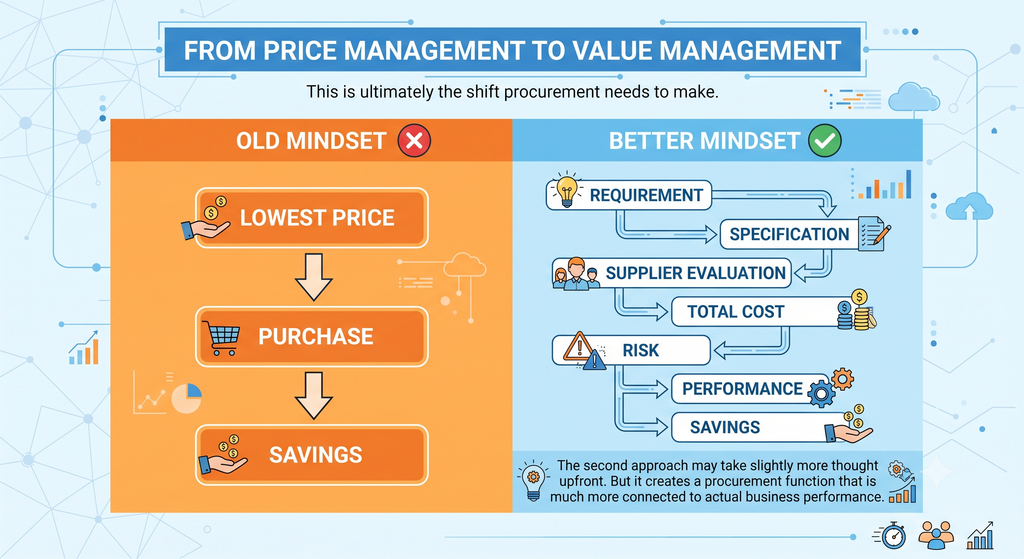
From Price Management to Value Management
This is ultimately the shift procurement needs to make.
Old mindset
Lowest Price → Purchase → Savings
Better mindset
Requirement → Specification → Supplier Evaluation → Total Cost → Risk → Performance → Savings
The second approach may take slightly more thought upfront.
But it creates a procurement function that is much more connected to actual business performance.
Final Thought
The cheapest vendor doesn’t automatically become a bad supplier.
And the most expensive vendor doesn’t automatically become a good one.
The mistake is choosing a supplier based on price alone.
Because the real cost of a purchase is determined not only by what appears on the invoice, but also by what happens after the invoice.
The cheapest vendor may win the quotation.
The supplier offering the best overall value may win the long-term business.
And that’s the real job of procurement:
Not simply to buy cheaper—but to help the business operate better at the lowest sustainable total cost.
- Printer Paper Buying Guide: Everything You Need to KnowChoosing the right printing paper significantly impacts your project’s outcome by determining durability, print quality, and appearance. Key considerations include paper size, weight, brightness, material, and whether it’s coated or uncoated. Options vary from eco-conscious to premium papers, accommodating every need from everyday office use to specialized high-quality prints. Brands like JK Copier and Century Papers typically offer diverse types tailored for inkjet, laser, and photo printing. Ensure the paper choice enhances your document’s overall look and feel, matching the specific requirements of your task.
- The Ultimate Guide to Glossy Photo PaperElevate Your Prints with Nasa Glossy Photo Paper When it comes to producing outstanding printed photographs, choosing the right photo paper is crucial. Among the various types available, glossy photo paper stands out as a favorite for both professionals and hobbyists. This comprehensive guide will explore the features, types, and applications of glossy photo paper,
- A4 size paper: Uses and Applications in Indiaa4 size paper (210 mm x 297 mm) is the most commonly used paper size in India for printing documents, letters, and official papers. This guide explains the versatility of the A paper sizes which maintain a 1:√2 aspect ratio, allowing for proportional scaling. Smaller sizes like A5 through A10 are derived by halving the previous size. Common binding methods for A sizes include comb, spiral, and thermal binding. Printable guides with detailed dimensions are available online. Essential uses of A4 paper include printing, photocopying, and crafting. Wisycart.com offers a variety of paper sizes for convenient online shopping and delivery in India.
- Wisycart – Your Ultimate Destination for Premium Office Supplies OnlineWelcome to Wisycart.com, your trusted B2B e-commerce platform, dedicated to providing a comprehensive selection of high-quality office supplies from top brands. We are committed to delivering an exceptional online shopping experience, offering exclusive prices, a diverse range of products, and seamless site navigation. A Vast Range of Top Brands in One PlaceAt Wisycart.com, we bring
- Camlin Whiteboard Marker Pens: Discover the ExcellenceDiscover the Camlin Whiteboard Marker Pen—your ultimate tool for bold, bright, and easy-to-erase writing. Perfect for professionals, students, and artists, this marker offers exceptional quality at an affordable price. Explore the full range today!
New arrivals
-
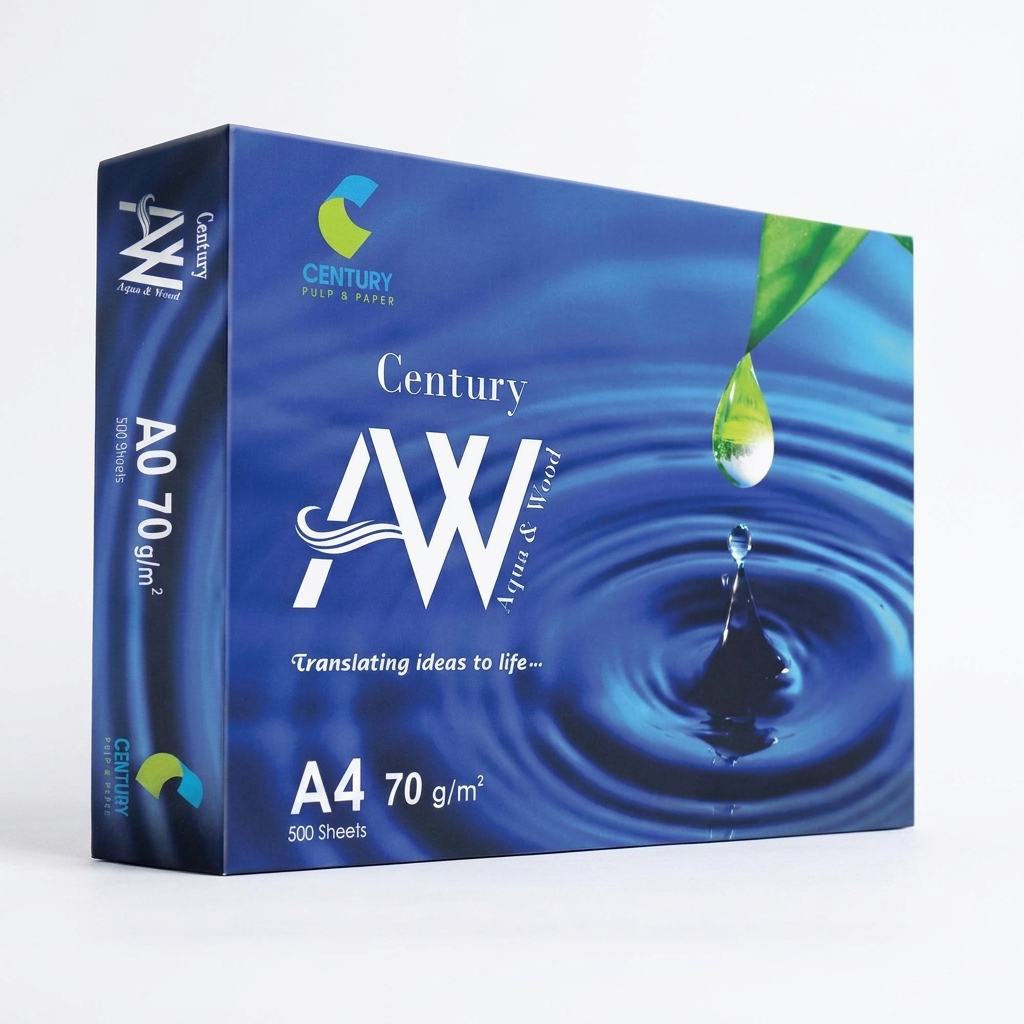
Century AW A4 Paper 70 GSM 500 Sheets – Pack of 20
Original price was: ₹4,999.₹3,760Current price is: ₹3,760. (GST Extra) -
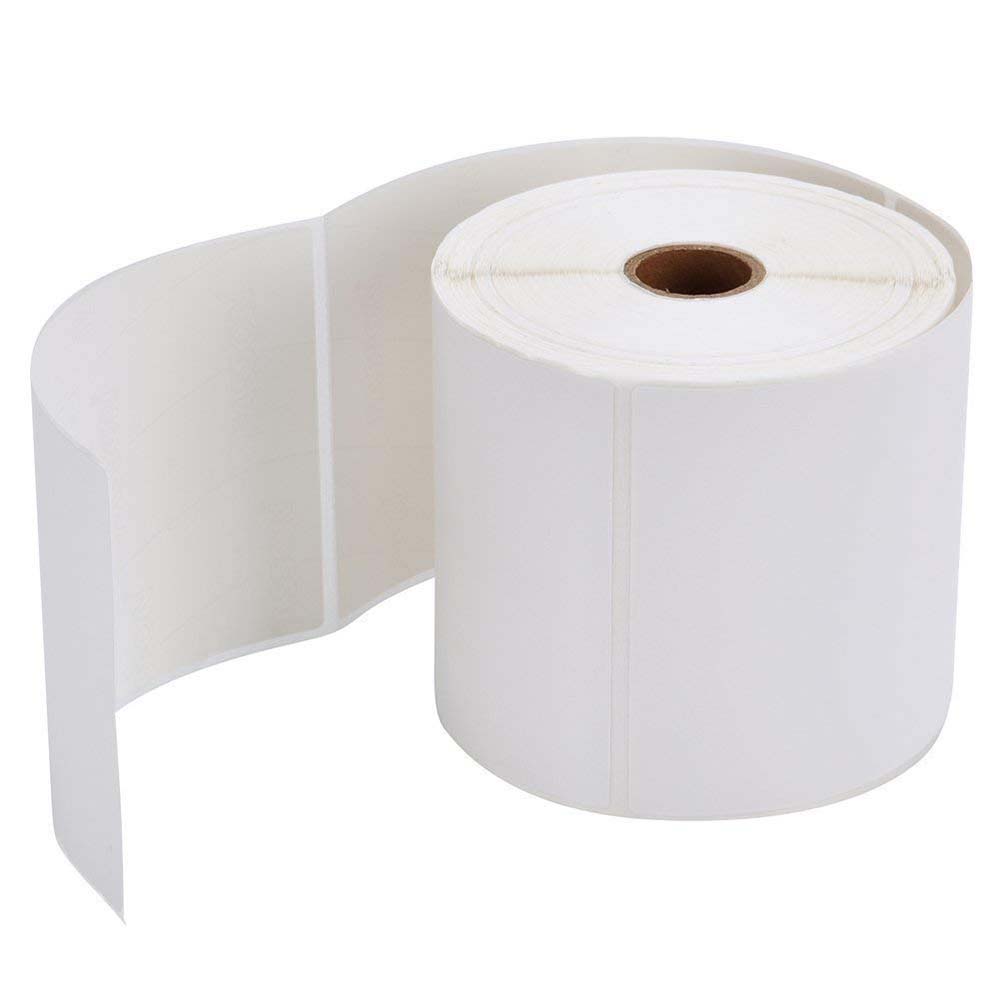
Thermal Shipping Labels 4 x 6 Inch | 400 Labels Per Roll | Direct Thermal
Original price was: ₹499.₹225Current price is: ₹225. (GST Extra) -
Omxe Measuring Tape 5 Metre
Original price was: ₹149.₹99Current price is: ₹99. (GST Extra) -
Camlin Permanent Marker Ink Red 500ml
Original price was: ₹555.₹455Current price is: ₹455. (GST Extra) -
Brother TN-B021 Original Genuine Toner Cartridge
Original price was: ₹940.₹750Current price is: ₹750. (GST Extra)



Recent Comments