
No products in the cart.
Introduction
Choosing the right supplier is only the first step in building an efficient procurement function. Long-term procurement success depends on how effectively businesses manage supplier relationships after onboarding.
Organizations that build strong supplier relationships often benefit from better pricing, consistent product quality, priority service, faster issue resolution, and improved supply chain resilience.
This process is known as Supplier Relationship Management (SRM).
Whether your business procures office stationery, copier paper, printer cartridges, housekeeping supplies, pantry consumables, IT equipment, or industrial materials, an effective SRM strategy helps transform suppliers into long-term business partners.
Table of Contents
What Is Supplier Relationship Management?
Supplier Relationship Management (SRM) is the systematic process of evaluating, engaging, monitoring, and improving relationships with suppliers to maximize long-term business value.
Unlike traditional purchasing, SRM focuses on collaboration, continuous improvement, and strategic partnerships rather than one-time transactions.
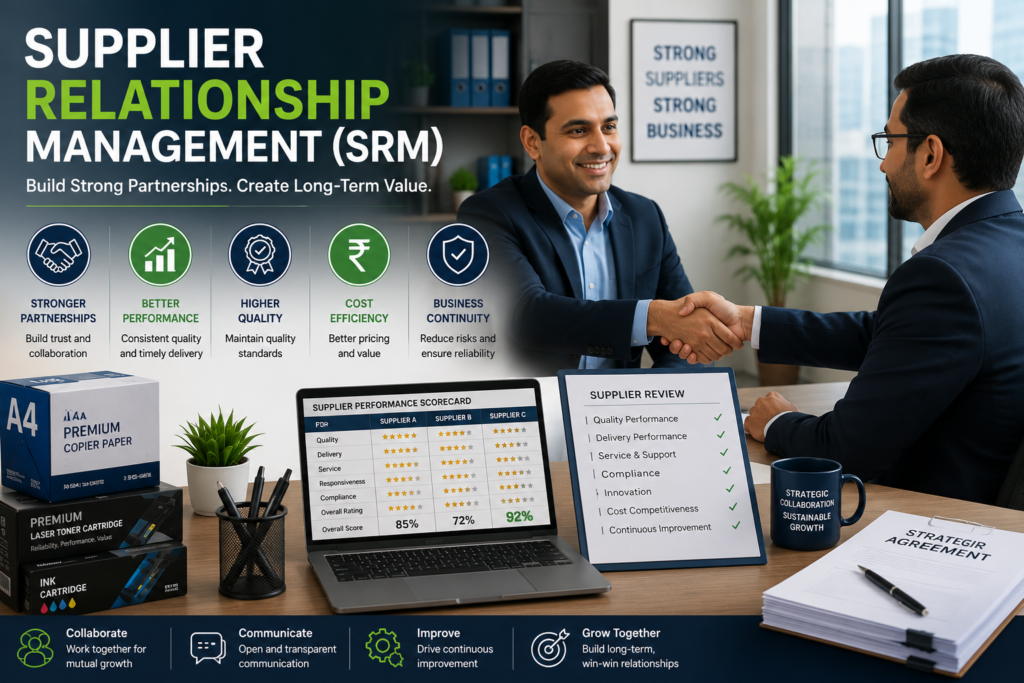
Why Supplier Relationship Management Matters
Strong supplier relationships help businesses:
- Improve product availability
- Reduce procurement risks
- Achieve better commercial terms
- Improve delivery performance
- Increase product quality
- Encourage innovation
- Strengthen business continuity
In today’s competitive environment, procurement success depends as much on supplier relationships as it does on pricing.
Benefits of Supplier Relationship Management
1. Better Supplier Performance
Regular communication and performance reviews help suppliers consistently meet quality and delivery expectations.
2. Improved Cost Efficiency
Long-term relationships often lead to better pricing, volume discounts, and reduced procurement costs.
3. Higher Product Quality
Suppliers who understand business expectations are more likely to maintain consistent quality standards.
4. Reliable Deliveries
Strong partnerships improve delivery commitments and reduce supply disruptions.
5. Faster Problem Resolution
Established relationships enable quicker communication and issue resolution.
6. Business Continuity
Trusted suppliers are more likely to support customers during market shortages and supply chain disruptions.
Key Components of Supplier Relationship Management
Supplier Segmentation
Not every supplier requires the same level of attention.
Classify suppliers based on:
- Strategic importance
- Annual spend
- Business impact
- Supply risk
Performance Monitoring
Track supplier KPIs such as:
- On-time delivery
- Quality performance
- Lead time
- Responsiveness
- Defect rate
- Order accuracy
Regular Business Reviews
Conduct periodic meetings to discuss:
- Performance trends
- Upcoming demand
- Improvement opportunities
- Future business plans
Collaboration
Share forecasts, consumption trends, and procurement plans to improve supplier preparedness.
Supplier Relationship Management Best Practices
Communicate Clearly
Maintain open and transparent communication with suppliers.
Set Performance Expectations
Define measurable service levels and procurement expectations.
Review Supplier KPIs
Use procurement metrics to monitor supplier performance objectively.
Encourage Continuous Improvement
Work collaboratively to improve quality, efficiency, and service.
Diversify Critical Suppliers
Avoid overdependence on a single supplier for business-critical products.
Common Supplier Relationship Mistakes
Businesses often weaken supplier relationships by:
- Selecting vendors based only on price
- Providing inaccurate demand forecasts
- Delaying payments
- Ignoring supplier feedback
- Evaluating suppliers only when problems occur
- Failing to review supplier performance regularly
Supplier Relationship Management Checklist
Use this checklist to strengthen supplier partnerships:
- Define supplier performance KPIs
- Schedule quarterly supplier reviews
- Monitor delivery performance
- Track quality issues
- Share procurement forecasts
- Review contract compliance
- Resolve issues promptly
- Recognize high-performing suppliers
- Maintain multiple qualified suppliers for critical categories
SRM vs Vendor Management
Although often used interchangeably, they are different.
Vendor Management focuses on supplier selection, contracts, compliance, and operational performance.
Supplier Relationship Management focuses on collaboration, long-term value creation, continuous improvement, and strategic partnerships.
Organizations with mature procurement functions typically implement both.
Conclusion
Supplier Relationship Management is no longer optional for organizations seeking procurement excellence.
Businesses that invest in strong supplier relationships often achieve better pricing, improved quality, reliable deliveries, lower procurement risks, and stronger operational resilience.
Whether sourcing office supplies, copier paper, printer cartridges, housekeeping materials, packaging products, or industrial goods, effective SRM transforms procurement from a transactional function into a strategic advantage.
Frequently Asked Questions
What is Supplier Relationship Management (SRM)?
Supplier Relationship Management is the process of building, managing, and improving long-term relationships with suppliers to maximize business value.
Why is SRM important?
SRM improves supplier performance, reduces procurement risks, strengthens collaboration, and helps businesses achieve better commercial outcomes.
What is the difference between SRM and Vendor Management?
Vendor Management focuses on supplier administration and compliance, while SRM emphasizes collaboration, continuous improvement, and strategic partnerships.
Which businesses should implement SRM?
Organizations of all sizes that regularly purchase office supplies, raw materials, equipment, or services can benefit from Supplier Relationship Management.
How often should supplier performance be reviewed?
Most businesses conduct quarterly performance reviews, while critical suppliers may be monitored monthly.
- Complete Office Supplies List for a New Office: 100+ Essential ItemsSetting up a new office can be exciting, but there is one practical question every business eventually faces: What office supplies do we actually need? A new office requires much more than desks, chairs and computers. From A4 paper and pens to files, printer supplies, housekeeping products, packaging materials and small office accessories, there are
- Centralized vs Local Stationery Procurement for Multi-Location CompaniesFor a company with one office, buying stationery is rarely complicated. For a company with 20, 50 or 100 branches, it can become a serious procurement challenge. Every branch needs basic office supplies: The question is: Should every branch purchase these products locally, or should the company centralize its stationery procurement? There is no universal
- How to Buy Office Supplies Online Across India: Complete Business GuideBuying office supplies for one office is relatively simple. Buying office supplies for a business with offices, branches or teams across different parts of India is a different challenge. A company may need stationery in Mumbai, A4 paper in Delhi, files in Bengaluru, printer consumables in Hyderabad and housekeeping supplies in Pune — all while
- How to Create an Approved Vendor List for Office SuppliesIntroduction Most companies have a list of suppliers. But having a list of suppliers and having an Approved Vendor List (AVL) are two different things. A supplier may have supplied your company for years. Another may offer the lowest quotation. A third may be recommended by a branch manager. But should all of them automatically
- Office Supplies Spend Analysis: How to Find Hidden Savings in ProcurementIntroduction Ask a company: “How much do you spend on office supplies?” The answer is often surprisingly difficult to produce. Finance may have the total expense. Procurement may have purchase orders. Individual departments may have their own records. Branches may be buying locally. And some purchases may be happening through petty cash, corporate cards or

Recent Comments