
No products in the cart.
Introduction
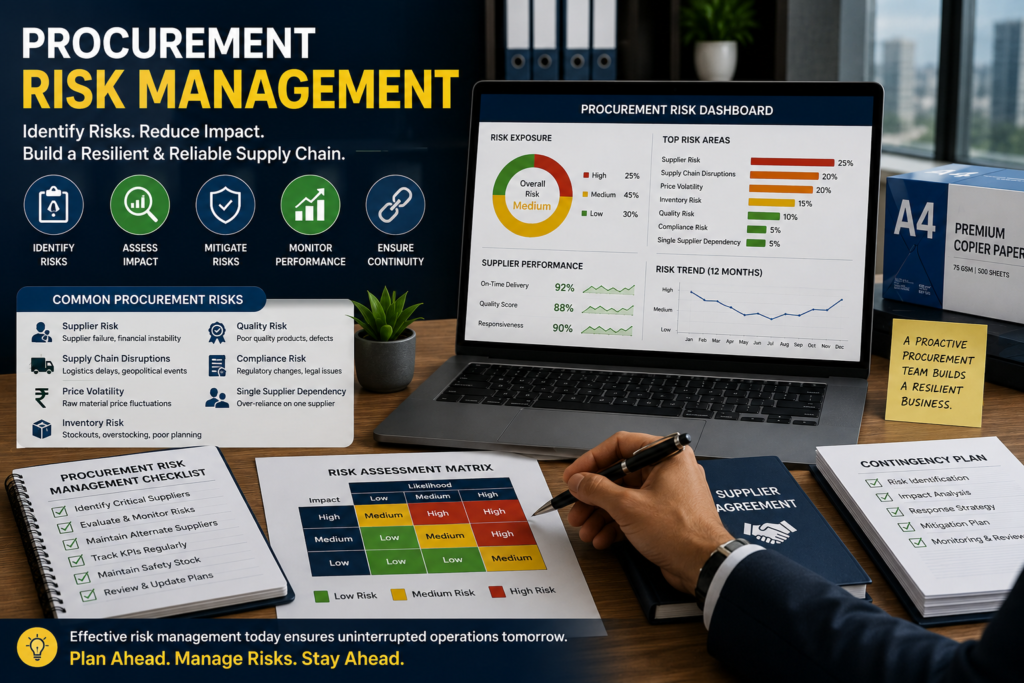
Procurement is no longer just about sourcing products at competitive prices. Businesses today face increasing risks from supplier failures, logistics disruptions, price volatility, regulatory changes, and unexpected market events.
Without a structured risk management approach, these challenges can lead to stock shortages, delayed operations, increased procurement costs, and dissatisfied customers.
Procurement Risk Management helps organizations identify, assess, and mitigate risks before they impact business operations.
Whether your organization purchases office stationery, copier paper, printer cartridges, housekeeping supplies, packaging materials, IT equipment, or industrial products, understanding procurement risks is essential for building a resilient supply chain.
Table of Contents
What Is Procurement Risk Management?
Procurement Risk Management is the process of identifying, evaluating, monitoring, and reducing risks associated with purchasing goods and services.
The objective is to ensure business continuity while minimizing financial, operational, and supplier-related disruptions.
Why Procurement Risk Management Matters
An effective procurement risk strategy helps businesses:
- Prevent supply disruptions
- Reduce unexpected procurement costs
- Improve supplier reliability
- Strengthen inventory planning
- Protect business continuity
- Improve customer satisfaction
- Enhance procurement decision-making
Common Procurement Risks
1. Supplier Risk
A supplier may fail to deliver due to financial instability, production issues, or operational challenges.
Mitigation:
- Conduct supplier evaluations
- Monitor supplier performance
- Maintain alternate suppliers
2. Supply Chain Disruptions
Transportation delays, port congestion, natural disasters, or geopolitical events can interrupt deliveries.
Mitigation:
- Diversify sourcing
- Increase visibility into supplier lead times
- Maintain critical inventory buffers
3. Price Volatility
Raw material costs and market fluctuations can significantly impact procurement budgets.
Mitigation:
- Long-term supplier agreements
- Spend analysis
- Forecast market trends
4. Inventory Risk
Poor inventory planning can result in stockouts or excess inventory.
Mitigation:
- Define reorder levels
- Maintain safety stock
- Monitor inventory turnover
5. Quality Risk
Substandard products increase operational costs and customer dissatisfaction.
Mitigation:
- Supplier audits
- Product quality inspections
- Performance scorecards
6. Compliance Risk
Suppliers may fail to meet legal, regulatory, or contractual obligations.
Mitigation:
- Verify certifications
- Review compliance documentation
- Conduct periodic audits
7. Single Supplier Dependency
Over-reliance on one supplier increases business vulnerability.
Mitigation:
- Develop approved alternate vendors
- Split procurement across qualified suppliers
Procurement Risk Assessment Matrix
Evaluate risks based on:
| Risk | Likelihood | Business Impact |
|---|---|---|
| Supplier Failure | High | High |
| Delivery Delay | High | Medium |
| Price Increase | Medium | High |
| Inventory Shortage | High | High |
| Quality Issue | Medium | High |
| Compliance Failure | Low | High |
Prioritize risks that have both high likelihood and high business impact.
Best Practices for Managing Procurement Risk
- Qualify suppliers before onboarding.
- Review supplier KPIs regularly.
- Monitor lead times and delivery performance.
- Maintain safety stock for critical products.
- Diversify strategic suppliers.
- Use procurement dashboards and analytics.
- Conduct annual supplier risk assessments.
Procurement Risk Management Checklist
✓ Identify critical suppliers
✓ Monitor supplier performance
✓ Review inventory risks
✓ Maintain alternate suppliers
✓ Track procurement KPIs
✓ Update risk assessments regularly
✓ Develop contingency plans
Conclusion
Procurement risk cannot be eliminated completely, but it can be managed effectively.
Businesses that proactively identify supplier, inventory, pricing, and compliance risks are better prepared to maintain operations during uncertainty.
A structured procurement risk management strategy not only protects the supply chain but also improves resilience, strengthens supplier relationships, and supports long-term business growth.
Frequently Asked Questions
What is procurement risk?
Procurement risk refers to any event that could negatively impact purchasing activities, supplier performance, inventory availability, or business continuity.
What are the biggest procurement risks?
Supplier failure, delivery delays, inventory shortages, price volatility, quality issues, and compliance failures are among the most common procurement risks.
How can businesses reduce procurement risk?
Businesses can reduce procurement risk through supplier evaluation, alternate sourcing, inventory planning, procurement KPIs, safety stock, and regular supplier performance reviews.
Why is procurement risk management important?
It helps organizations minimize disruptions, reduce costs, improve supplier reliability, and ensure uninterrupted business operations.
- Summer events essentials to make your event shineSummer is here, bringing with it a season full of family gatherings, corporate outings, and school activities. As you plan your outdoor events, make sure you’re prepared for both the fun and the cleanup with essential supplies from Wisycart.com. From keeping your spaces clean to managing waste efficiently, Wisycart.com has everything you need to ensure
- Finding the best Ink, Toner or Cartridges for Your Printer: A Guide 2024Discover the benefits of using compatible cartridges from Wisycart.com! Save money without sacrificing quality with our wide range of affordable, high-performance printer cartridges. Perfect for home and business use.
- Maximizing Savings and Efficiency: A Guide to Buying Office Supplies with Wisycart.comRunning a business can be expensive, and one of the largest costs for many companies is office supplies. From printer paper to pens and sticky notes, these supplies add up quickly, draining your budget and taking your focus away from more important tasks. But what if you could save money and improve efficiency when purchasing
- TNPL Platinum Copier Paper: The Cost-Effective Choice for Everyday PrintingTNPL Platinum Copier Paper: The Cost-Effective Choice for Everyday Printing When it comes to choosing a reliable and cost-effective paper for your everyday printing needs, TNPL Platinum Copier Paper stands out as a top choice. This high-quality paper is perfect for both home and office use, providing excellent results for a wide range of printing
- Century Elanza A4 size Paper: Quality Prints & Affordable PriceWhen it comes to selecting the best copier paper for your printing needs, the Century Elanza Copier Paper stands out for its exceptional quality and performance. This 70 gsm A4 size paper is designed to deliver clear, crisp prints every time. Here’s everything you need to know about Century Elanza Copier Paper, including its price,

Recent Comments