
No products in the cart.
Introduction
Ordering office supplies sounds simple.
You need paper, files, pens, printer consumables, housekeeping products or packaging material.
You check the price.
You place the order.
Done.
But in a growing organisation, office supplies procurement can involve much more than selecting a product and comparing quotations.
A small mistake in the specification can result in the wrong product.
A low price can hide higher consumption or poor reliability.
A rushed order can create unnecessary delivery costs.
And a lack of planning can turn a routine purchase into an emergency purchase.
That’s why a simple procurement checklist can be surprisingly useful.
The objective isn’t to make procurement complicated. It is to make sure the important things aren’t missed.
Table of Contents
Why Do You Need an Office Supplies Procurement Checklist?
Office supplies are usually high-frequency, repetitive purchases.
That creates a unique challenge.
Individual orders may be small, but the cumulative spend can be significant.
A company might purchase:
- Hundreds of reams of paper
- Thousands of pens
- Hundreds of files
- Printer consumables every month
- Regular housekeeping supplies
- Packaging materials across multiple locations
When these purchases aren’t standardised, companies can experience:
- Different prices for the same product
- Different products across locations
- Duplicate suppliers
- Stockouts
- Excess inventory
- Emergency purchases
- Poor visibility
- Unnecessary administrative work
A checklist provides a simple control mechanism.
The 15-Point Office Supplies Procurement Checklist
1. What Exactly Do We Need?
Start with the requirement—not the supplier.
Ask:
What problem are we trying to solve?
For example:
Instead of:
“Buy A4 paper.”
The requirement could be:
“A4 copier paper suitable for high-volume office printing and compatible with our existing printers.”
That creates a much better starting point.
2. Is the Specification Clearly Defined?
Before requesting prices, define the product specification.
Depending on the category, this could include:
Copier Paper
- Size
- GSM
- Brightness
- Opacity
- Required certification
- Printer compatibility
Toner
- Printer model
- Cartridge number
- Original/compatible requirement
- Expected page yield
Packaging
- Length
- Width
- Height
- Material
- Thickness
- Load requirement
Cleaning Products
- Product type
- Concentration
- Intended application
- Pack size
Never compare prices before confirming that you’re comparing equivalent products.
3. Is There an Approved Product Already?
Before introducing a new SKU, check whether the organisation already has an approved equivalent.
For example, if the company already has an approved:
A4 Copier Paper — 75 GSM
there may be little reason for another department to introduce three different 75 GSM papers unless there is a specific requirement.
Standardisation can simplify:
- Procurement
- Inventory
- Training
- Storage
- Price negotiation
- Consumption analysis
4. Do We Really Need a New Supplier?
This is an important question.
A new supplier may appear attractive because of a lower quotation.
But before onboarding another vendor, ask:
- Do we already have an approved supplier?
- Can our existing supplier meet the requirement?
- Can the existing supplier improve pricing?
- Does the new supplier offer something materially different?
More suppliers do not automatically mean better procurement.
Sometimes they simply mean more vendor management.
5. Have We Compared Like-for-Like Prices?
Never compare only:
₹200 vs ₹190
Check the complete commercial structure.
For example:
| Factor | Supplier A | Supplier B |
|---|---|---|
| Product | ₹200 | ₹190 |
| Delivery | Free | ₹15 |
| Taxes | Extra | Extra |
| MOQ | 10 | 50 |
| Payment Terms | 30 days | Advance |
| Lead Time | 2 days | 6 days |
Suddenly, the ₹190 quotation doesn’t look quite as straightforward.
The procurement team should compare the effective landed cost and commercial terms, not simply the headline price.
6. What Is the Minimum Order Quantity?
MOQ can significantly affect procurement decisions.
Suppose your monthly requirement is:
50 units
but the supplier requires:
500 units MOQ.
The unit price may be attractive.
But now you need to consider:
- Storage
- Working capital
- Inventory risk
- Product damage
- Consumption rate
- Obsolescence
A lower unit price isn’t necessarily beneficial if it forces the company to carry excessive inventory.
7. How Much Do We Actually Consume?
Historical consumption is one of the most useful procurement inputs.
Look at:
Last month → Last 3 months → Last 6 months → Seasonal variation
For example:
| Month | A4 Paper Consumption |
|---|---|
| January | 420 reams |
| February | 450 |
| March | 470 |
| April | 430 |
| May | 520 |
| June | 510 |
This is much better than guessing:
“Let’s order 1,000 reams because the price is good.”
Procurement should be connected to actual consumption.
8. What Is the Reorder Point?
Don’t wait until the last box is opened.
Define when a replenishment order should be triggered.
For example:
Average monthly consumption: 500 units
Supplier lead time: 7 days
Safety stock: 150 units
The organisation can establish a suitable reorder point based on these factors.
The exact calculation will vary by product.
The important principle is:
Reorder before the business reaches a critical shortage—not after.
9. Is the Supplier Reliable?
Price isn’t enough.
Check the supplier’s actual performance.
Consider:
- On-time delivery
- Order accuracy
- Product quality
- Response time
- Replacement handling
- Stock availability
- Invoice accuracy
A supplier who consistently delivers correctly may be more valuable than one who occasionally offers a slightly lower price.
10. Can the Supplier Deliver to All Required Locations?
This becomes particularly important for multi-location organisations.
A supplier may be excellent in Mumbai but unable to efficiently service:
- Delhi
- Bengaluru
- Hyderabad
- Pune
- Kolkata
Before signing a central contract, understand the supplier’s geographic coverage and delivery model.
Sometimes the right answer is:
One central supplier
while in other cases:
Central contract + regional fulfilment
may work better.
11. What Happens If the Product Is Defective?
Before ordering, understand the supplier’s:
- Return policy
- Replacement process
- Credit-note process
- Damage claim procedure
- Escalation mechanism
This becomes especially important for recurring procurement.
The question isn’t:
“Will something go wrong?”
Eventually, something probably will.
The question is:
“What happens when it does?”
12. Are There Any Compliance Requirements?
Some products require additional checks.
Depending on the category, consider:
- BIS requirements
- GST documentation
- Food-contact requirements
- Environmental certifications
- Product-specific regulatory requirements
- Manufacturer declarations
Don’t assume that every product category has the same compliance requirements.
The procurement specification should identify what is actually relevant.
13. How Will the Goods Be Received?
Procurement should continue beyond ordering.
At delivery, verify:
Quantity
Did we receive what we ordered?
Specification
Is it the correct product?
Condition
Is anything damaged?
Packaging
Is the material properly packed?
Documentation
Are the required delivery documents available?
For organisations using a formal procurement process, receipt confirmation or a GRN (Goods Receipt Note) provides an important control point before invoice processing.
14. Does the Purchase Need Approval?
Define the appropriate approval level before placing the order.
For example:
Routine low-value purchase
→ Department/Admin approval
Medium-value purchase
→ Manager/Procurement approval
High-value purchase
→ Senior management approval
The exact limits should be defined by the organisation.
The objective is to prevent two extremes:
No control
and
Too much bureaucracy.
15. Have We Considered Total Cost?
Finally, ask the most important question:
“What will this purchase actually cost the business?”
Consider:
Purchase Price
Delivery
Wastage
Storage
Administrative Effort
Replacement
Potential Downtime
Emergency Procurement
This doesn’t mean every purchase needs a complicated TCO calculation.
For a ₹100 stationery item, a detailed analysis may not make sense.
For a high-volume or operationally critical category, it can be extremely valuable.
The 5-Minute Pre-Order Check
If you don’t have time to go through all 15 points for every routine order, use this shorter version:
Before placing the order, ask:
☐ Do we need it?
☐ Is the specification correct?
☐ Are we buying the right quantity?
☐ Is the supplier reliable?
☐ Is the total cost competitive?
If all five answers are clear, you’re already avoiding many common procurement mistakes.
A Practical Office Supplies Procurement Workflow
A well-controlled process can look like:
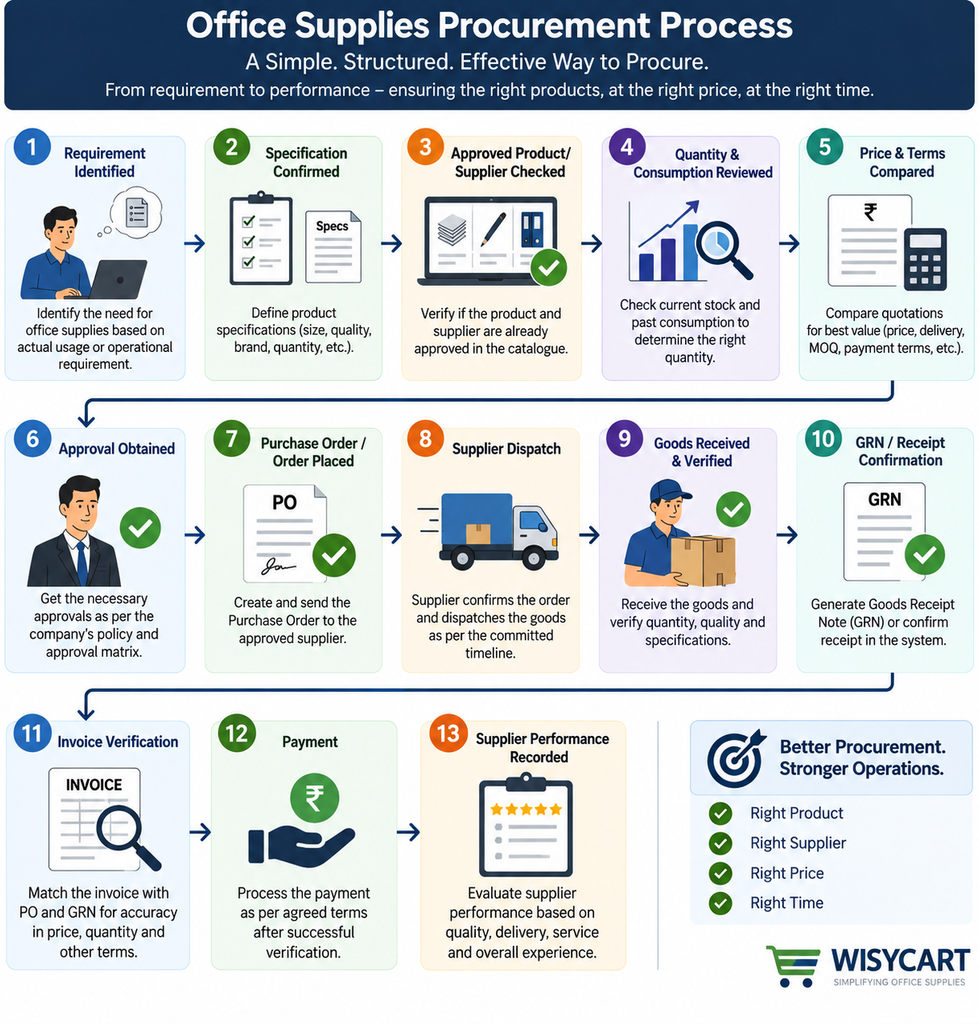
The process doesn’t have to be complicated.
It simply needs to be repeatable.
What Should a Procurement Team Measure?
A checklist is useful.
But measurement makes it more powerful.
Consider tracking:
Purchase Price
Are negotiated prices actually improving?
On-Time Delivery
How reliably do suppliers deliver?
Stockouts
How frequently do critical supplies run out?
Emergency Purchases
How often does poor planning create urgent buying?
Maverick Spend
How much is purchased outside approved suppliers or processes?
Order Accuracy
How frequently are the wrong products or quantities delivered?
Supplier Performance
Which suppliers consistently meet expectations?
Common Mistakes to Avoid
Buying Before Defining the Requirement
This creates confusion later.
Comparing Different Specifications
The lowest quotation may simply be for an inferior or different product.
Ordering Based on Price Alone
A lower unit price may come with higher total cost.
Ignoring Consumption History
This can create both stockouts and excess inventory.
Adding Too Many Suppliers
Supplier fragmentation can reduce purchasing leverage and increase administrative work.
No Emergency Procurement Rules
Without a defined exception process, employees may bypass normal controls.
No Supplier Performance Tracking
If supplier performance isn’t measured, poor performance can continue unnoticed.
Conclusion
Good office supplies procurement isn’t about making every purchase complicated.
It is about making sure that the important questions are answered before money is spent.
Before placing an order, procurement teams should know:
What are we buying?
Why are we buying it?
What specification do we need?
How much do we need?
Who should supply it?
What will it really cost?
When do we need it?
How will we verify the delivery?
For a small office, this may take only a few minutes.
For a large organisation with multiple departments and locations, these simple checks can create significant improvements in cost control, consistency, inventory management and supplier performance.
The best procurement process isn’t the one with the most approvals.
It’s the one that consistently gets the right product, from the right supplier, at the right total cost, at the right time.

Recent Comments