
No products in the cart.
Introduction
Every business invests in office assets to support its daily operations. From laptops and printers to office furniture and networking equipment, these assets represent a significant investment that requires proper tracking and management.
Without an effective asset management system, businesses often face challenges such as misplaced equipment, duplicate purchases, unexpected maintenance costs, compliance issues, and unnecessary capital expenditure.
Office Asset Management helps organizations monitor, maintain, and optimize the lifecycle of their physical assets, ensuring better utilization, cost savings, and operational efficiency.
Whether you manage a small office or a multi-location enterprise, implementing effective asset management practices can improve productivity while reducing operational risks.
Table of Contents
What Is Office Asset Management?
Office Asset Management is the process of tracking, maintaining, and managing all physical assets owned by an organization throughout their lifecycle.
It involves identifying assets, recording their details, assigning ownership, scheduling maintenance, monitoring usage, and planning replacements or disposal when assets reach the end of their useful life.
An effective asset management system provides complete visibility into business assets, helping organizations make informed purchasing and maintenance decisions.
Why Is Office Asset Management Important?
Proper asset management offers several business benefits:
- Prevents asset loss and theft
- Improves utilization of office equipment
- Reduces unnecessary purchases
- Supports preventive maintenance
- Simplifies audits and compliance
- Extends asset lifespan
- Improves budgeting and procurement planning
- Enhances employee accountability
Businesses that maintain accurate asset records can reduce operational costs while improving workplace efficiency.
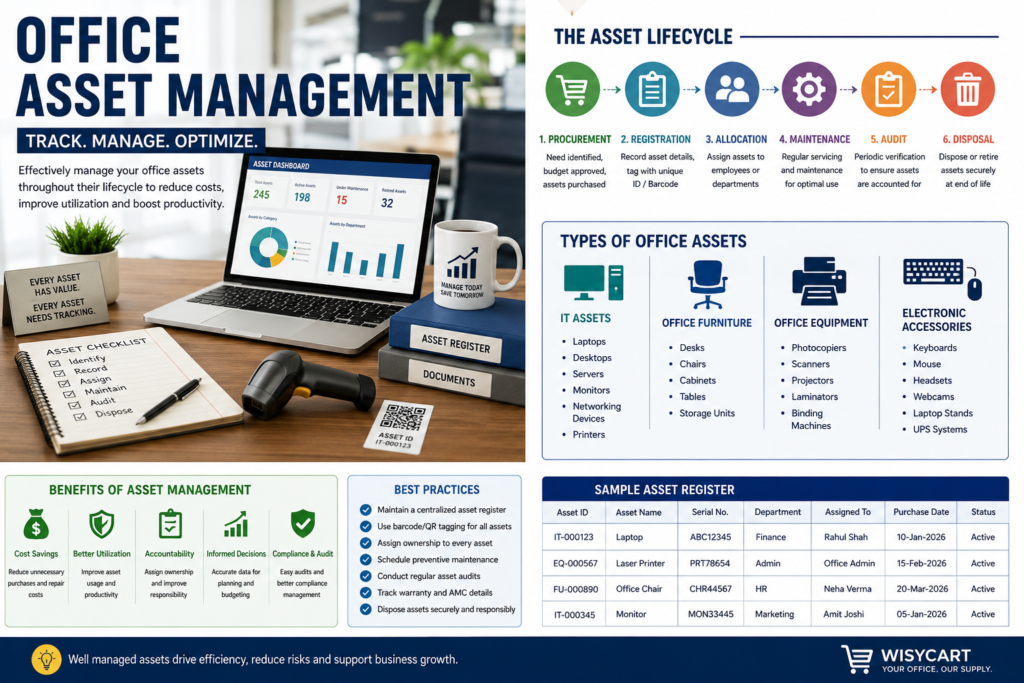
Types of Office Assets
Office assets can generally be categorized into the following groups:
1. IT Assets
Examples include:
- Laptops
- Desktop computers
- Servers
- Monitors
- Printers
- Networking equipment
- External storage devices
These assets often require software tracking, warranty management, and periodic upgrades.
2. Office Furniture
Examples include:
- Office desks
- Chairs
- Storage cabinets
- Conference tables
- Reception furniture
Although furniture typically has a longer lifespan, it still requires maintenance and inventory tracking.
3. Office Equipment
Examples include:
- Photocopiers
- Scanners
- Projectors
- Televisions
- Video conferencing systems
- Laminators
- Binding machines
Proper maintenance helps maximize the return on investment for these assets.
4. Electronic Accessories
These include:
- Keyboards
- Mouse devices
- Webcams
- Headsets
- Docking stations
- Laptop stands
- UPS systems
While individually lower in value, these assets are frequently misplaced if not properly tracked.
The Office Asset Lifecycle
Every office asset follows a lifecycle consisting of several stages.
1. Procurement
The asset is identified, approved, purchased, and recorded.
Key activities include:
- Requirement identification
- Vendor selection
- Purchase Order creation
- Invoice recording
- Asset registration
2. Asset Registration
Each asset should receive:
- Asset ID
- Barcode or QR Code
- Serial Number
- Purchase Date
- Warranty Details
- Assigned Department
- Assigned Employee
Maintaining an asset register ensures complete visibility.
3. Allocation
Assets are assigned to employees or departments.
This stage should record:
- Allocation date
- Employee details
- Asset condition
- Expected return date (if applicable)
4. Maintenance
Regular maintenance helps reduce unexpected breakdowns.
Examples include:
- Printer servicing
- Laptop cleaning
- UPS battery replacement
- Software updates
- Calibration of office equipment
Preventive maintenance usually costs less than emergency repairs.
5. Audit & Verification
Periodic physical verification ensures records match actual assets.
Asset audits help identify:
- Missing assets
- Damaged equipment
- Idle assets
- Underutilized assets
- Unauthorized transfers
6. Disposal
Assets reaching the end of their useful life should be disposed of securely.
Methods include:
- Recycling
- Resale
- Trade-in
- Donation
- Certified e-waste disposal
Proper disposal also helps maintain data security for electronic devices.
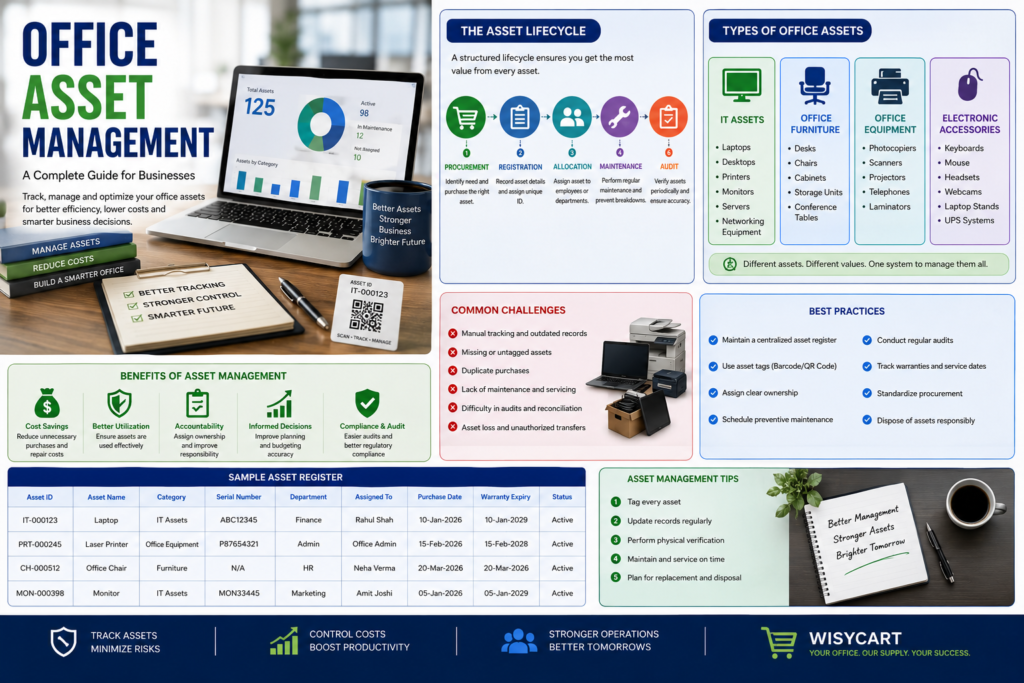
Common Challenges in Office Asset Management
Many organizations face issues such as:
- Manual spreadsheets becoming outdated
- Missing or untagged assets
- Duplicate purchases
- Untracked warranties
- Poor maintenance scheduling
- Lack of accountability
- Difficulty locating equipment
- Inaccurate depreciation records
These challenges increase operational costs and reduce asset utilization.
Best Practices for Effective Office Asset Management
Maintain a Centralized Asset Register
Record every office asset from the day it is purchased.
Use Asset Tags
Barcode or QR code labels make tracking easier during audits.
Assign Asset Ownership
Every asset should have a clearly assigned employee or department.
Schedule Preventive Maintenance
Regular servicing increases asset lifespan and reduces downtime.
Perform Periodic Audits
Verify physical assets against records at least once or twice a year.
Track Warranties
Maintain warranty expiry dates to avoid unnecessary repair expenses.
Standardize Procurement
Purchasing standardized equipment simplifies maintenance and inventory management.
Sample Office Asset Register
| Asset ID | Asset Name | Serial Number | Department | Assigned To | Purchase Date | Warranty Expiry | Status |
|---|---|---|---|---|---|---|---|
| IT-001 | Laptop | ABC12345 | Finance | Rahul Shah | 10-Jan-2026 | 10-Jan-2029 | Active |
| EQ-015 | Laser Printer | PRT78654 | Admin | Office Admin | 15-Feb-2026 | 15-Feb-2028 | Active |
Common Mistakes Businesses Should Avoid
- Purchasing assets without proper approval
- Failing to maintain an updated asset register
- Ignoring preventive maintenance
- Not conducting periodic audits
- Delaying disposal of obsolete equipment
- Assigning assets without documentation
Avoiding these mistakes helps businesses improve accountability and reduce unnecessary expenditure.
Frequently Asked Questions
What is office asset management?
Office asset management is the process of tracking, maintaining, and managing office assets throughout their lifecycle.
What is an asset register?
An asset register is a centralized record containing details of all business assets, including identification numbers, purchase information, ownership, and maintenance history.
Why is asset tagging important?
Asset tags help businesses quickly identify, locate, and audit office equipment while reducing the risk of loss or theft.
How often should businesses conduct asset audits?
Most organizations perform physical asset verification annually, while businesses with high-value assets may conduct quarterly audits.
What are examples of office assets?
Examples include laptops, desktop computers, printers, photocopiers, office furniture, networking equipment, projectors, keyboards, mice, and other office equipment.
Conclusion
Office Asset Management is more than maintaining an inventory of office equipment. It is a strategic process that helps businesses optimize asset utilization, control costs, improve accountability, and extend the lifespan of valuable resources.
By implementing structured asset registration, preventive maintenance, regular audits, and standardized procurement practices, organizations can improve operational efficiency while making better long-term investment decisions.
As businesses grow, effective asset management becomes an essential component of procurement, finance, administration, and facility management, ensuring every asset delivers maximum value throughout its lifecycle.

Recent Comments