
No products in the cart.
Introduction
Every successful procurement process depends on accurate documentation. While Purchase Orders authorize the purchase of goods, businesses also need a systematic way to verify that the ordered items have actually been received.
This is where a Goods Receipt Note (GRN) becomes essential.
A Goods Receipt Note records the receipt of goods delivered by a supplier and confirms whether the quantity and condition of the items match the Purchase Order.
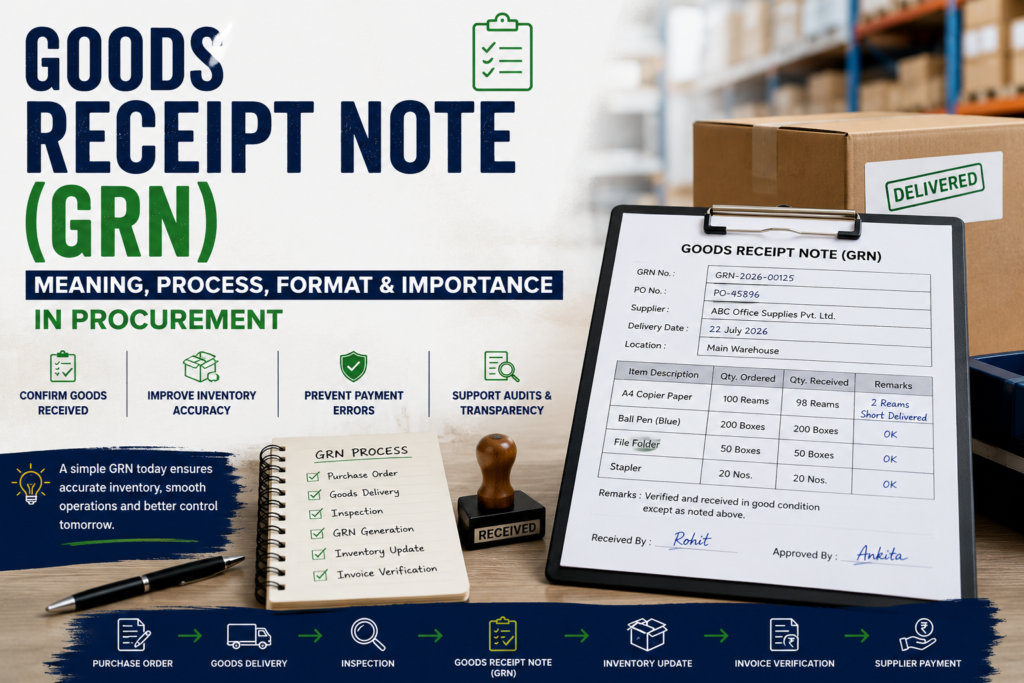
Whether your organization procures office stationery, copier paper, printer cartridges, IT equipment, housekeeping supplies, or industrial materials, a GRN helps improve inventory accuracy, supplier accountability, and financial control.
In this guide, you’ll learn what a Goods Receipt Note is, why it’s important, how the GRN process works, and best practices for managing goods receipts efficiently.
Table of Contents
What Is a Goods Receipt Note (GRN)?
A Goods Receipt Note (GRN) is an internal document prepared by the receiving department after goods are delivered by a supplier.
The GRN confirms that the goods have been received and inspected. It records the quantity, condition, and any discrepancies before inventory is updated and supplier invoices are processed.
A GRN is usually generated after a Purchase Order has been fulfilled and before supplier payment is approved.
Why Is a Goods Receipt Note Important?
A Goods Receipt Note plays a critical role in procurement and inventory management by:
- Confirming receipt of ordered goods
- Updating inventory records accurately
- Detecting shortages or damaged items
- Supporting supplier invoice verification
- Improving procurement transparency
- Preventing unauthorized payments
- Maintaining audit-ready documentation
Without a GRN, businesses may pay for products that were never delivered or fail to identify discrepancies during receiving.
What Information Does a GRN Contain?
A typical Goods Receipt Note includes:
- GRN Number
- Purchase Order Number
- Supplier Name
- Delivery Date
- Receiving Location
- Product Description
- Quantity Ordered
- Quantity Received
- Unit of Measure
- Item Condition
- Inspection Remarks
- Received By
- Authorized By
Many organizations also include barcode or QR code references for easier inventory tracking.
Goods Receipt Process
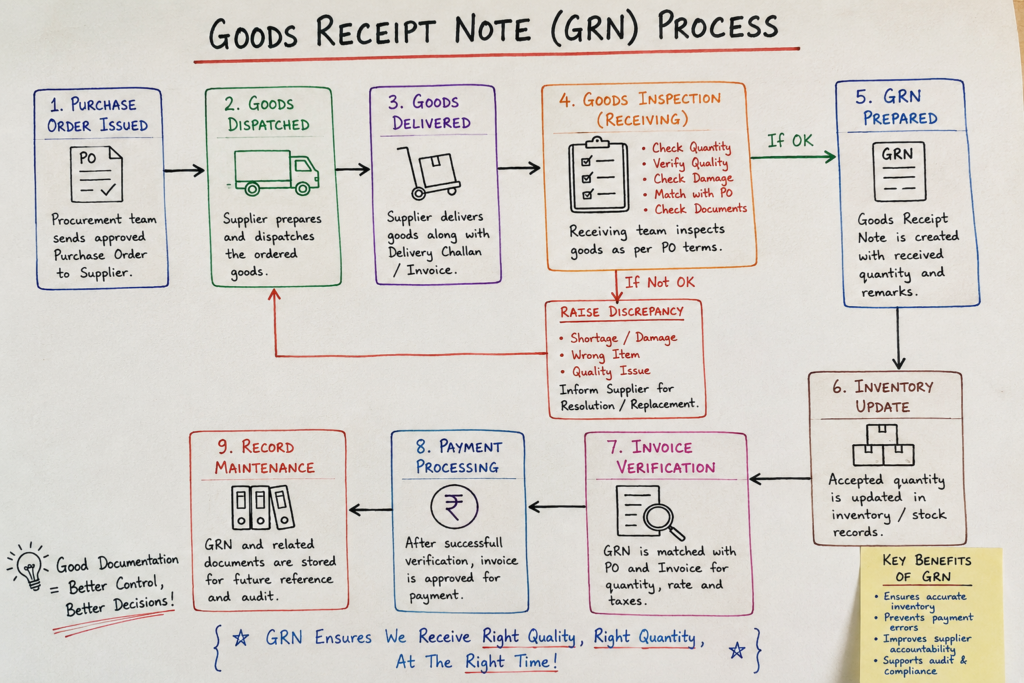
The standard goods receipt process generally follows these steps:
Step 1: Purchase Order Issued
The procurement team places an approved Purchase Order with the supplier.
Step 2: Goods Delivered
The supplier delivers the ordered items along with the delivery challan or invoice.
Step 3: Physical Verification
The receiving team verifies:
- Product specifications
- Quantity received
- Packaging condition
- Visible damage
- Batch numbers (if applicable)
Step 4: GRN Preparation
Once verification is completed, the Goods Receipt Note is prepared.
Any shortages, excess quantities, or damaged items should be clearly recorded.
Step 5: Inventory Update
Approved quantities are added to inventory or warehouse stock.
Step 6: Invoice Verification
The GRN is matched against the Purchase Order and supplier invoice before payment processing.
Goods Receipt Note Workflow
Benefits of Using a GRN
Improves Inventory Accuracy
Only verified goods are added to inventory records.
Prevents Payment Errors
Finance teams can verify deliveries before releasing supplier payments.
Enhances Supplier Accountability
Discrepancies can be documented immediately.
Supports Procurement Audits
GRNs provide complete documentation for internal and external audits.
Reduces Procurement Disputes
Proper receiving records minimize disagreements between buyers and suppliers.
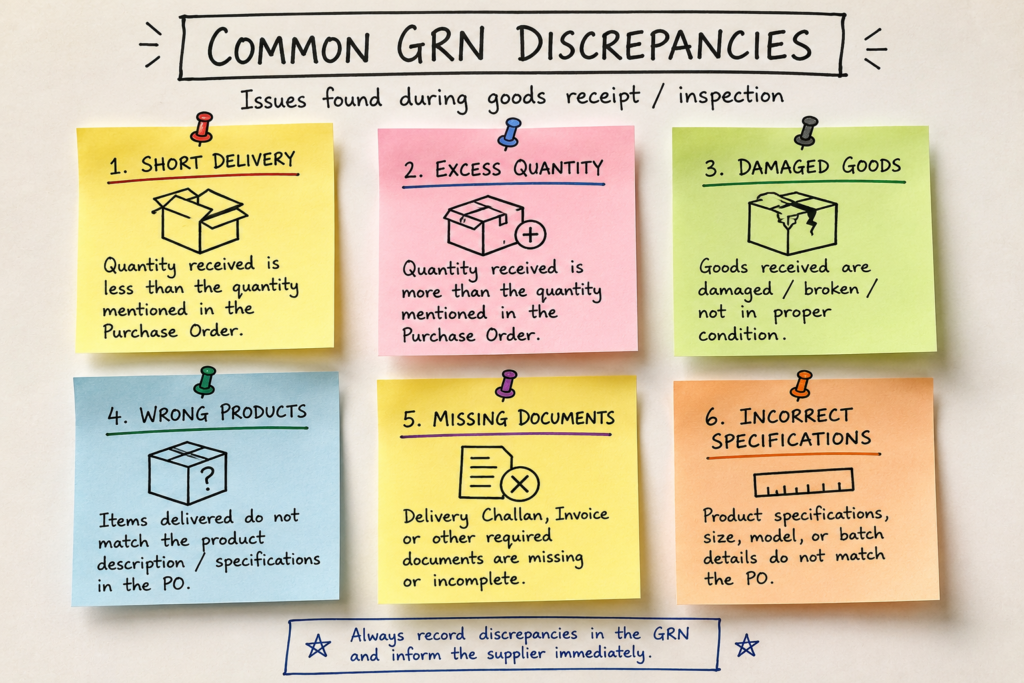
Common GRN Discrepancies
Receiving teams may encounter:
- Short deliveries
- Excess quantities
- Damaged products
- Wrong products delivered
- Missing documentation
- Incorrect product specifications
Such issues should be recorded in the GRN before inventory is updated.
Sample Goods Receipt Note Format
| Field | Example |
|---|---|
| GRN Number | GRN-2026-00125 |
| Purchase Order | PO-45896 |
| Supplier | ABC Office Supplies Pvt Ltd |
| Delivery Date | 22 July 2026 |
| Product | A4 Copier Paper |
| Quantity Ordered | 100 Reams |
| Quantity Received | 98 Reams |
| Remarks | 2 Reams Short Delivered |
| Received By | Store Executive |
| Approved By | Procurement Manager |
Best Practices for Managing GRNs
Verify Before Accepting
Always inspect products before completing the GRN.
Record Discrepancies Immediately
Damaged or missing goods should be documented at the time of receipt.
Link GRNs with Purchase Orders
This ensures every delivery corresponds to an approved purchase.
Digitize Goods Receipt
Using ERP or procurement software reduces manual errors and improves traceability.
Maintain GRN Records
Retain GRNs for audits, inventory reconciliation, and supplier performance reviews.
Common Mistakes Businesses Should Avoid
- Preparing GRNs without physical inspection
- Accepting damaged goods without remarks
- Updating inventory before verification
- Failing to record shortages
- Losing GRN documentation
- Delaying communication with suppliers
Frequently Asked Questions
What is the purpose of a Goods Receipt Note?
A Goods Receipt Note confirms that ordered goods have been received, inspected, and accepted into inventory.
Who prepares a GRN?
A GRN is typically prepared by the warehouse, stores, or receiving department after verifying the delivered goods.
Is a GRN mandatory?
The requirement depends on company policies, but most organizations use GRNs to maintain procurement controls and support invoice verification
What happens if there is a shortage in delivery?
The shortage should be recorded in the GRN, and the supplier should be informed before invoice processing.
What is the difference between a Delivery Challan and a GRN?
A Delivery Challan is issued by the supplier when goods are dispatched. A Goods Receipt Note is created by the buyer after verifying that the goods have been received.
Conclusion
A Goods Receipt Note is one of the most important documents in the procurement lifecycle. It bridges purchasing, inventory, and finance by confirming that goods have been received as ordered before inventory is updated and payments are processed.
By implementing a structured GRN process, businesses can improve inventory accuracy, reduce procurement disputes, strengthen supplier accountability, and maintain reliable audit records. Whether managed manually or through an ERP system, a well-maintained Goods Receipt Note is essential for efficient and transparent procurement operations.

Recent Comments