
No products in the cart.
Introduction
Packaging regulation in India is moving beyond simply asking whether a package protects its contents.
Increasingly, regulators are also looking at what materials are used, how those materials interact with food, and what happens to the packaging after use.
A significant example is the Food Safety and Standards Authority of India’s (FSSAI) 2026 action concerning packaging materials for pan masala.
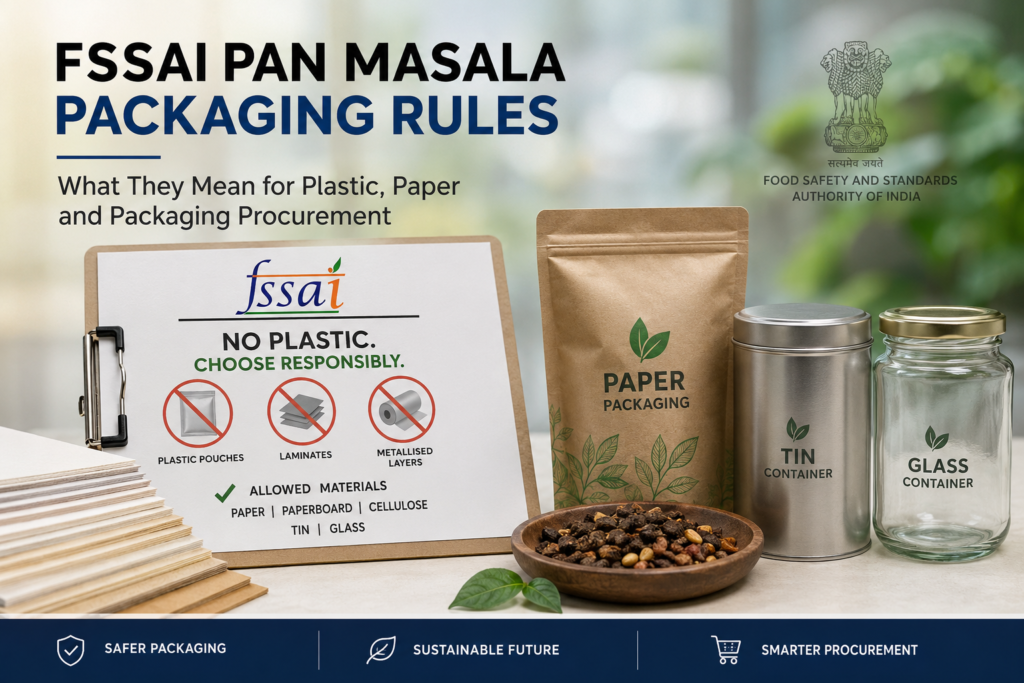
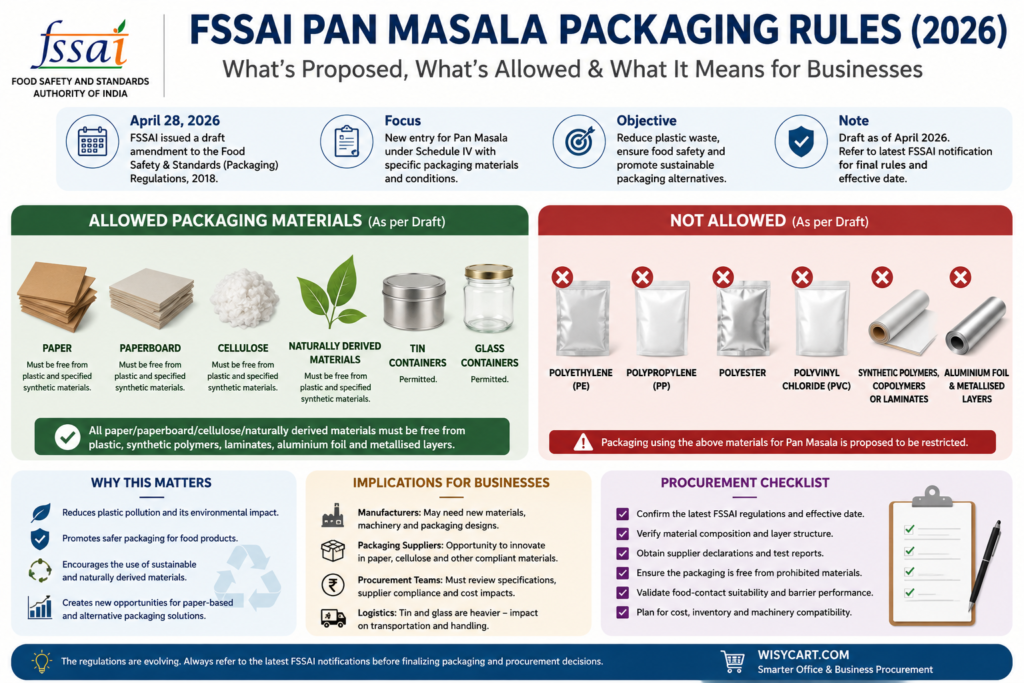
In April 2026, FSSAI published a draft amendment to the Food Safety and Standards (Packaging) Regulations, 2018, proposing a specific entry for pan masala under Schedule IV. The draft specified paper, paperboard, cellulose and other naturally derived materials free from plastic, synthetic polymers, aluminium foil and metallised layers, while also permitting tin or glass containers.
Recent reporting in August 2026 indicates that FSSAI has moved ahead with stricter pan masala packaging norms, including restrictions on plastic-based and plastic-laminated packaging. However, FSSAI’s publicly accessible notification archive currently continues to identify the April notification as a draft, so businesses should verify the latest operative notification and effective date before making compliance decisions.
This development is important not only for pan masala manufacturers, but also for packaging converters, paper and paperboard suppliers, procurement teams and businesses evaluating alternatives to conventional plastic-based flexible packaging.
What Has FSSAI Proposed for Pan Masala Packaging?
The April 28, 2026 draft amendment proposed adding a new entry for Pan Masala to Schedule IV of the Food Safety and Standards (Packaging) Regulations, 2018.
The proposed materials included:
- Paper
- Paperboard
- Cellulose
- Other naturally derived materials
- Tin containers
- Glass containers
However, the paper, paperboard, cellulose and naturally derived materials specified in the draft were subject to a critical condition:
They must be free from plastic and specified synthetic materials.
The draft specifically referred to:
- Polyethylene (PE)
- Polypropylene (PP)
- Polyester
- Polyvinyl chloride (PVC)
- Synthetic polymers
- Synthetic copolymers
- Laminates
- Aluminium foil
- Metallised layers
This distinction is extremely important.
A paper-based package containing a plastic or metallised barrier layer would not automatically qualify merely because its outer surface looks like paper.
Is This Simply a “Plastic Ban”?
That description is useful for headlines, but it is incomplete.
India already has restrictions on the use of plastic packaging for gutkha, tobacco and pan masala under the Plastic Waste Management framework.
The FSSAI proposal adds a specific packaging-material entry for pan masala within the food packaging regulatory framework. The draft also reproduced relevant provisions of Rule 4(1) of the Plastic Waste Management Rules, 2016 concerning plastic sachets and plastic packaging for gutkha, tobacco and pan masala.
Therefore, this should not be interpreted as:
“India has suddenly banned plastic packaging for all food products.” It is a product-specific regulatory development.
What Packaging Materials Are Relevant?
The proposed framework creates an interesting comparison between different packaging formats.
| Material | Position in FSSAI draft | Key consideration |
|---|---|---|
| Paper | Permitted subject to conditions | Must be free from specified plastic/material layers |
| Paperboard | Permitted subject to conditions | Barrier and food-contact performance remain important |
| Cellulose | Permitted subject to conditions | Must meet the specified material requirements |
| Naturally derived materials | Permitted subject to conditions | Must satisfy the regulatory specification |
| Tin | Permitted | Heavier and structurally different from flexible packaging |
| Glass | Permitted | Rigid packaging with different logistics and handling characteristics |
| Plastic-based packaging | Restricted/prohibited under the specified framework | Particularly relevant to sachets and synthetic polymer structures |
| Aluminium/metallised layers | Excluded from the specified paper-based option | Important for multilayer flexible packaging |
The table describes the April 2026 draft framework, not a blanket statement about every packaging application in India.
Why Paper and Paperboard Are Getting Attention
At first glance, paper appears to be the obvious replacement for a plastic pouch.
In reality, it is more complicated.
A packaging material has to perform several functions simultaneously:
- Protect the product
- Maintain product quality
- Provide sufficient mechanical strength
- Resist moisture where necessary
- Provide suitable barrier properties
- Permit sealing or closure
- Support printing and branding
- Meet applicable food-contact requirements
- Survive transportation and handling
Traditional plastic multilayer structures are often designed precisely because they can combine several of these functions in a relatively lightweight package.
Moving to paper or paperboard therefore isn’t simply a matter of replacing one material with another.
It can require new packaging structures, coatings, machinery, sealing systems and supply chains.
The Important Difference Between “Paper Packaging” and “Plastic-Free Paper Packaging”
This may become one of the most important procurement lessons from the proposed rules.
Consider a hypothetical flexible pack:
Paper + Plastic Layer + Aluminium/Metallised Layer
It may look like paper from the outside.
But from a material perspective, it is a multilayer structure.
The FSSAI draft specifically excludes paper/paperboard/cellulose materials containing plastic, specified synthetic polymers, copolymers or laminates, and aluminium foil or metallised layers.
Therefore:
“Paper-based” does not automatically mean “plastic-free.”
For procurement teams, material specifications and supplier declarations will matter far more than the appearance of the package.
What Could This Mean for Packaging Manufacturers?
If the stricter framework becomes operational in the form proposed/reported, manufacturers using conventional plastic-based pan masala sachets may need to evaluate:
Packaging Material
Alternative paper, paperboard, cellulose or other permitted structures.
Machinery
Existing filling and sealing machinery may not necessarily work with a completely different packaging substrate.
Barrier Performance
A new material may require different approaches to moisture, aroma, grease or other product-protection requirements.
Supply Chain
New materials may require new suppliers, converters and quality-control processes.
Cost
A material change can affect:
- Packaging material cost
- Conversion cost
- Machinery
- Transportation
- Storage
- Wastage
- Production speed
The final commercial impact will depend on the packaging format and technology adopted by individual manufacturers.
What Does This Mean for Packaging Procurement?
For procurement teams, the most important change is conceptual.
The question should no longer be:
“Can we buy a paper-based pouch?”
It should be:
“Does the proposed packaging structure meet the applicable regulatory and technical requirements?”
A proper procurement specification may need to cover:
- Substrate
- GSM or thickness
- Fibre/material composition
- Barrier properties
- Food-contact suitability
- Adhesives/coatings
- Presence of plastic layers
- Presence of metallised layers
- Printing system
- Sealability
- Supplier declarations
- Testing and compliance documentation
This is where packaging procurement becomes a technical exercise rather than a simple price comparison.
Tin and Glass Are Also Part of the Equation
The discussion should not be reduced to:
Plastic → Paper
The FSSAI draft also lists tin or glass containers as permissible packaging options for pan masala.
These materials have different characteristics.
Tin
Potential advantages:
- Rigid structure
- Strong physical protection
- Reusable/recyclable metal stream potential
Potential challenges:
- Higher weight
- Different manufacturing requirements
- Higher transportation and handling implications compared with lightweight flexible packaging
Glass
Potential advantages:
- Rigid and inert packaging material
- Strong premium appearance
- Established food-packaging applications
Potential challenges:
- Weight
- Breakage risk
- Transportation requirements
- Storage and handling
Therefore, the most suitable packaging solution will depend on the product, manufacturing process, distribution model and commercial positioning.
Does This Mean Paper Is Automatically More Sustainable?
No.
This is another area where businesses should avoid oversimplification.
A packaging material’s environmental performance depends on more than whether it contains paper.
Relevant factors can include:
- Raw material sourcing
- Manufacturing energy
- Water consumption
- Material weight
- Transport
- Recyclability
- Collection infrastructure
- End-of-life treatment
- Actual recovery rates
A paper structure that contains multiple incompatible layers may have very different recycling characteristics from a simple fibre-based structure.
Therefore, plastic-free and sustainable are related concepts, but they are not synonyms.
Why This Matters Beyond Pan Masala
The immediate regulatory issue is specific to pan masala packaging.
But the larger industry signal is broader.
India’s packaging ecosystem is increasingly dealing with questions around:
- Plastic reduction
- Food-contact safety
- Recyclability
- Extended Producer Responsibility
- Alternative materials
- Sustainable procurement
- Packaging waste
The Government’s wider work also includes initiatives around alternative packaging technologies. In January 2026, the Office of the Principal Scientific Adviser convened stakeholders to discuss the use of bioplastics in sachets for paan masala and gutkha, with participation from FSSAI, MoEFCC, BIS, IIP and other stakeholders.
FSSAI has also been involved in BIOPACKATHON 2026, a biodegradable packaging solution challenge for pan masala and gutkha sachets, in collaboration with the Department of Consumer Affairs and BIS.
This suggests that the regulatory and technology discussion is still evolving.
One Important Regulatory Distinction
Businesses should distinguish between three different things:
1. Existing Restrictions
India has long-standing restrictions on plastic sachets and plastic packaging for gutkha, tobacco and pan masala under the Plastic Waste Management framework.
2. FSSAI’s 2026 Packaging Amendment
FSSAI’s April 2026 draft proposed a specific entry in the Food Safety and Standards (Packaging) Regulations for pan masala, including permissible materials and exclusions.
3. Current Enforcement Position
This is where businesses must be careful.
FSSAI’s public notification archive currently lists the April notification as a draft, while recent August 2026 reporting describes stricter norms as having been introduced. Businesses should therefore rely on the latest operative FSSAI notification and effective date before changing packaging specifications or making compliance representations.
What Should Packaging Buyers Do Now?
For businesses affected by the change, a sensible approach is:
1. Review Current Packaging Structures
Don’t just identify the outer material.
Understand the complete structure.
2. Ask Suppliers for Material Declarations
Obtain written specifications covering layers, polymers, coatings and metallised components.
3. Separate “Paper-Based” From “Plastic-Free”
These are not necessarily the same thing.
4. Test Alternative Structures
A compliant material still needs to work on the production line and protect the product.
5. Review Machinery Requirements
Changing packaging substrates may affect filling, forming and sealing equipment.
6. Monitor the Final Regulatory Position
Do not make major procurement decisions solely on a news headline or an early draft.
What Does This Mean for the Paper Industry?
This is potentially significant—but it would be premature to claim that the development will automatically create a massive new market for ordinary paper.
The relevant opportunity is likely to be in specialised packaging grades and converted packaging structures, not simply conventional office paper.
That distinction matters.
A4 copier paper and food-contact packaging paper are completely different procurement categories with different technical requirements.
For the paper and packaging industry, the more interesting question is therefore:
Can scalable, commercially viable, food-compatible and genuinely plastic-free fibre-based packaging structures deliver the required barrier and performance characteristics?
That is a much more meaningful industry question than simply asking whether paper can replace plastic.
So my conclusion from above is :
FSSAI’s 2026 action on pan masala packaging is an important development for India’s packaging industry.
The real story, however, is not simply “plastic is being replaced by paper.”
The more important shift is toward specified packaging materials, material transparency, food-contact considerations and alternative packaging technologies.
The headline is about pan masala. The larger lesson is about where India’s packaging industry may be heading.
For manufacturers and procurement teams, the next phase will involve much more than finding a paper supplier. It will require understanding the complete packaging structure, validating performance, reviewing machinery compatibility, obtaining supplier documentation and monitoring the final regulatory position.
For the paper and packaging industry, this could become an important test case for whether genuinely plastic-free fibre-based packaging can move from a sustainability concept to a scalable commercial solution.
Sources & Regulatory References
- FSSAI — Draft Food Safety and Standards (Packaging) Amendment Regulations, 2026: The primary regulatory document for the proposed pan masala packaging entry.
- FSSAI Notifications Archive: Currently lists the April 2026 pan masala packaging amendment as a draft notification.
- PIB — Stakeholder consultation on bioplastics for paan masala and gutkha sachets: Provides context on the government’s broader exploration of alternative packaging technologies.
- FSSAI BIOPACKATHON 2026: Government-backed initiative concerning biodegradable packaging solutions for pan masala and gutkha sachets.
Regulatory Disclaimer:
This article is intended for general informational and educational purposes only. It discusses FSSAI’s 2026 developments concerning pan masala packaging based on publicly available regulatory documents and official communications. Regulatory requirements, draft provisions, effective dates and enforcement positions may change. Readers should refer to the latest notifications, regulations and directions issued by FSSAI and other competent authorities before making packaging, procurement or compliance decisions.
The article does not constitute legal, regulatory, technical or compliance advice. Wisycart does not represent that any particular packaging material is compliant for a specific product or application. Food businesses and packaging manufacturers should independently verify applicable requirements and obtain appropriate technical and regulatory advice before changing packaging specifications.
Check our other posts:

Recent Comments