
No products in the cart.
Introduction
Every movement of goods in a business doesn’t necessarily involve an immediate sale or invoice. Businesses frequently transport goods for job work, stock transfers, demonstrations, repairs, replacements, exhibitions, or before issuing a tax invoice.
In such situations, a Delivery Challan serves as an important commercial document that accompanies the goods during transportation.
Whether you’re a manufacturer, wholesaler, distributor, retailer, procurement team, warehouse manager, or logistics professional, understanding the purpose of a Delivery Challan helps ensure smooth inventory management, regulatory compliance, and accurate documentation.
In this guide, we’ll explain what a Delivery Challan is, when it should be used, its format, benefits, and how it differs from an invoice.
Table of Contents
What Is a Delivery Challan?
A Delivery Challan (DC) is a document issued by the supplier or seller when goods are dispatched without raising a tax invoice at the time of transportation.
It acts as proof that goods have been sent from one location to another and contains important details about the shipment.
A Delivery Challan is commonly used for:
- Stock transfers
- Goods sent for job work
- Goods sent on approval
- Sample deliveries
- Repair or maintenance
- Replacement of damaged goods
- Goods sent for exhibitions
- Goods transported before invoice generation
Why Is a Delivery Challan Important?
A Delivery Challan helps businesses:
- Track movement of goods
- Maintain inventory accuracy
- Support logistics operations
- Document goods in transit
- Reduce delivery disputes
- Maintain GST compliance in applicable situations
- Provide proof of dispatch
Without a Delivery Challan, businesses may find it difficult to establish the purpose of transporting goods.
When Is a Delivery Challan Used?
Some common business scenarios include:
Goods Sent for Job Work
Raw materials or semi-finished goods are sent to another vendor for processing.
Stock Transfer Between Branches
Products are moved from one warehouse or branch to another.
Goods Sent on Approval
Customers receive products before making a purchase decision.
Sample Distribution
Marketing or sales teams distribute free samples.
Replacement Goods
Damaged or defective products are replaced.
Repair & Maintenance
Equipment is sent for servicing.
Exhibition or Display
Products are transported for exhibitions or trade fairs.
Information Included in a Delivery Challan
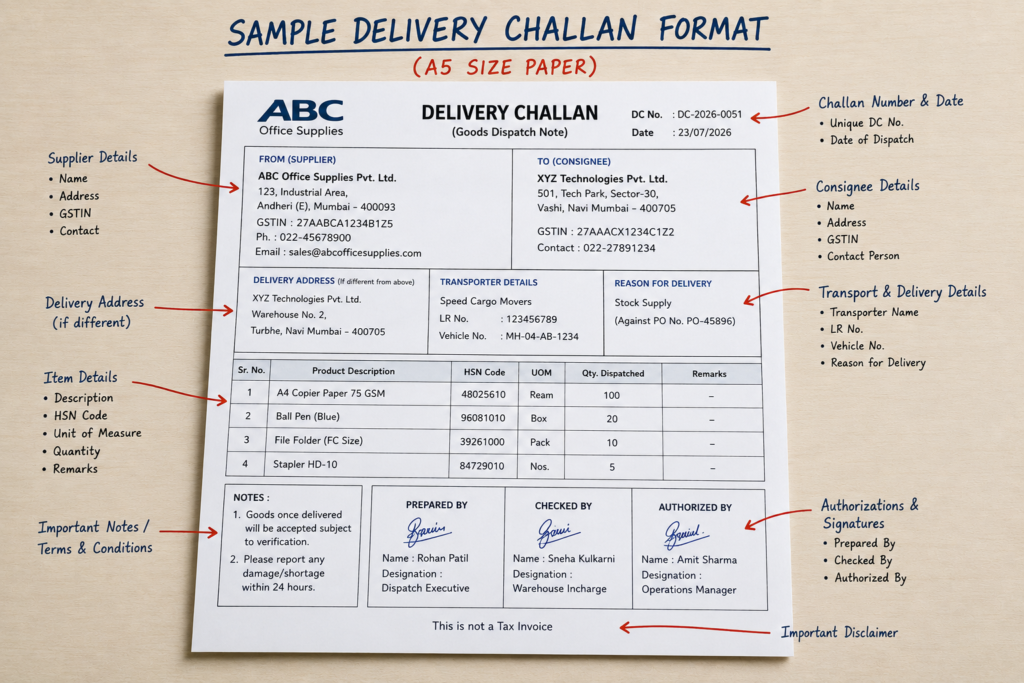
A standard Delivery Challan generally contains:
- Delivery Challan Number
- Date
- Supplier Name
- Supplier GSTIN (where applicable)
- Customer Name
- Delivery Address
- Product Description
- Quantity
- Unit of Measure
- Vehicle Details (if required)
- Transporter Information
- Reason for Delivery
- Authorized Signature
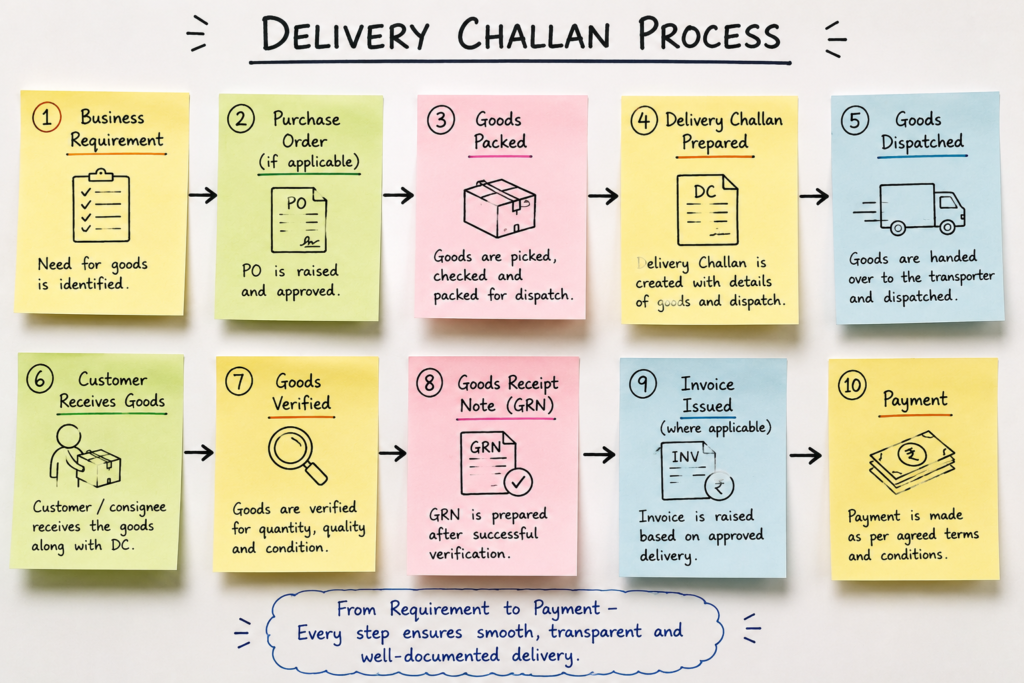
Delivery Challan Process
Sample Delivery Challan Format
Delivery Challan vs Invoice
| Delivery Challan | Invoice |
|---|---|
| Records movement of goods | Records sale of goods |
| May not involve payment | Used for payment collection |
| May not create tax liability immediately | Used for raising payment |
| Supports transportation | Supports accounting and taxation |
| Generated before or without invoice | Generated after sale |
Delivery Challan vs Goods Receipt Note (GRN)
Many people confuse these two documents.
| Delivery Challan | Goods Receipt Note |
|---|---|
| Issued by Supplier | Issued by Buyer |
| Confirms dispatch | Confirms receipt |
| Travels with goods | Prepared after inspection |
| External document | Internal document |
| Before delivery | After delivery |
Think of it simply:
Supplier → Delivery Challan
Buyer → Goods Receipt Note (GRN)
Benefits of Using Delivery Challans
Better Inventory Tracking
Helps monitor goods moving between locations.
Improved Logistics
Ensures transport teams have complete shipment details.
Fewer Delivery Disputes
Provides documentary proof of dispatched items.
Easier Goods Verification
Customers can match received products against the challan.
Better Audit Trail
Supports procurement, inventory, and finance documentation.
Common Mistakes Businesses Should Avoid
- Sending goods without a Delivery Challan
- Incorrect product descriptions
- Wrong quantities
- Missing signatures
- Missing challan numbers
- Not mentioning the reason for delivery
- Failing to retain challan copies
Best Practices
✔ Use serially numbered Delivery Challans
✔ Clearly mention the reason for dispatch
✔ Verify quantities before dispatch
✔ Keep digital records
✔ Link Delivery Challans with Purchase Orders and GRNs
✔ Train warehouse and dispatch teams
Frequently Asked Questions
Is a Delivery Challan mandatory?
It depends on the nature of goods movement and applicable regulations. In many business scenarios, especially where goods move without an immediate tax invoice, a Delivery Challan is commonly used for documentation.
Can a Delivery Challan replace an Invoice?
No.
A Delivery Challan records the movement of goods, whereas an Invoice records the sale and payment transaction.
Who prepares a Delivery Challan?
The supplier, seller, warehouse, or dispatch department prepares the Delivery Challan before goods are transported.
Is GST charged on a Delivery Challan?
A Delivery Challan itself is not a tax invoice. Whether GST applies depends on the nature of the transaction and applicable GST provisions.
What happens after the customer receives the goods?
The customer verifies the goods and prepares a Goods Receipt Note (GRN) if everything matches the order.
Conclusion
A Delivery Challan is much more than a transport document—it plays a crucial role in inventory control, logistics, procurement, and business documentation. It helps businesses track goods in transit, reduce disputes, improve warehouse operations, and maintain accurate records.
When used alongside Purchase Orders, Goods Receipt Notes (GRNs), and Invoices, a Delivery Challan forms an essential part of a transparent and efficient procurement process.

Recent Comments